
Maharam Stories

A HOUSE BUILT OUT OF CARPETS

In The Principle of Cladding, one of many polemics by Adolf Loos, the Austrian architect defined the profession’s task as “providing a warm and liveable space”. One evolving from the tradition of the coverings of early built structures — made from animal skins or textiles. “Carpets are warm and liveable”…

In The Principle of Cladding, one of many polemics by Adolf Loos, the Austrian architect defined the profession’s task as “providing a warm and liveable space”. One evolving from the tradition of the coverings of early built structures — made from animal skins or textiles. “Carpets are warm and liveable,” Loos wrote. “He [the architect] decides for this reason to spread out one carpet on the floor and to hang up four to form the four walls.”

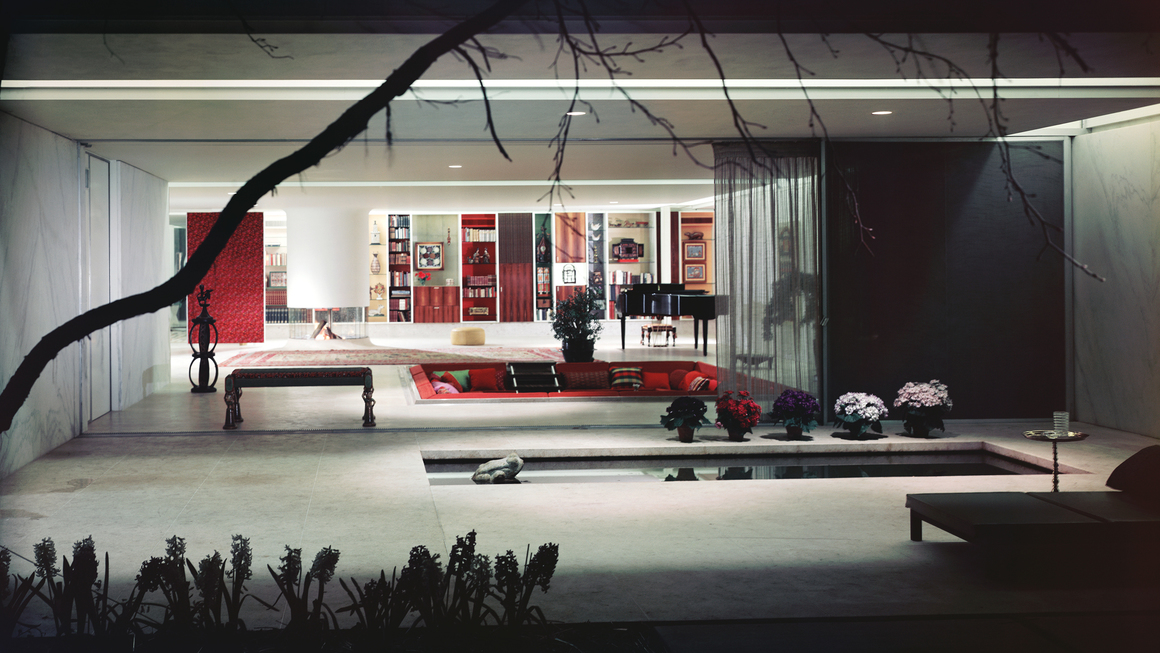
In 1903, five years after publishing the essay, Loos designed a bedroom for his wife, Lina. Within the white walls was a layer of ‘cladding’: white linen curtains strung on a rail that circled the room, a white Angora sheepskin rug that stretched over the bed frame like moss, with linen curtains and ‘skirts’ masking wardrobes, and draping bedside tables. The interior looks warm, soft, and contained — enveloping the body in a “bag of fur and cloth” — while the semi-sheer curtains also present the bedroom as a sort-of stage, or frame for observation.

Loos saw architecture and interiors as theatrical, and the inhabitants of his buildings both the observer and observed. While seeking comfort and warmth through architecture, Loos’s environments maintained a degree of detachment that meant any softness was balanced with a sense of control. The house was to be designed in harmony with the character of its inhabitants, that character split between the public and private spaces, the social and intimate being.

While his public statements were clear to the point of dogmatic, in reality Loos was a mess of contradictions. He argued for the task of the architect being to not “imitate” or dress up materials as something else, and was defensive of the idea that a living space constructed from rugs would be classed an imitation: “The walls are not really built out of carpets! Certainly not. But these carpets are meant only to be carpets and not building stones.” Loos was tyrannical in his disdain for “imitation and surrogate art”, artificial stone tiles, or painted inlays, and would often hurl his critiques as sexist slurs. He warned against ornament and decor as women’s work, women being “primitive, ignoble savages” in comparison to the “cool and detached” modern man. But the soft, fluffy, bedroom of Lina Loos, with its curved edges, sheer fabric and shining silver metal, is neither cool or detached. It embraces ornament, high camp and decor, and as is often true, Lina likely had more to do with it than the record shows.

But this split between the public and private self, of the self in principle and in practice, was a constant in Loos’s life. In public his judgements and moralism led to a rift with the Secession movement, long diatribes, and many drawn-out, public arguments; while in private he had three short marriages to women at least half his age, and was found guilty of child sexual abuse. In ‘Sex, Lies and Decoration: Adolf Loos and Gustav Klimt’, architectural theorist Beatriz Colomina wrote: “Loos’ public moralism denouncing ornament as a savage perversion is perhaps a pathological symptom of what it attacks, a disguise, a displacement.”

Loos sought the control of the senses within his architecture, and the formal order of the theatre box became the frame within which he worked. A space that is both private and a setting understood for performance or at least a position from which you will be viewed and projected onto. In the house Loos designed for Josephine Baker, she became the ‘primary object’, with reflective surfaces and openings between rooms shifting attention consistently back on her. But the primacy of the visual is denied through his writing, where he focuses on the “mind’s eye” of the architect, and his sense of what “he [the architect] wishes to exert upon the spectator”. The principle that the person inhabiting the house is the spectator, and not he — the architect — the external voice, shows how Loos thought about the people he designed for. Loos saw his role as providing a “warm and liveable space”, but the way that he detached life from work, theory from practice, interior from exterior, dislocated the potential for his work to contain a sense of ease, as the home becomes a stage.


Maharam Stories

BETTY WOODMAN

Betty Woodman’s first foray into ceramics was a high school pottery class, which set off a career-long relationship with clay, moving from the potential of functional pottery — “the cup you drink from… can change your life!” — to the abstracted vessels of her later work.

Betty Woodman’s first foray into ceramics was a high school pottery class, which set off a career-long relationship with clay, moving from the potential of functional pottery — “the cup you drink from… can change your life!” — to the abstracted vessels of her later work.

Woodman studied ceramics at the School for American Craftsman at Alfred University, where she produced a custard cup as her graduating project; it was a post-graduation summer in Italy that would form her idiosyncratic outlook on and approach to making ceramics. She was excited by how frescoes and Etruscan pottery overlapped with and stood among everyday life: how a room could be brought to life by painting scenes over the walls, or how ceramics can be “a marriage of painting and form.” She saw pots depicted in Roman and Egyptian wall paintings, and worlds portrayed on pots; in Woodman’s eyes, “the vessel is always there, throughout the history of man.” She understood functional pottery as a practice that could idealistically serve society — what we use and handle in our day-to-day lives impacting our quality of life. But, in addition to embracing pottery’s potential to transform the everyday, Woodman fought for the recognition of ceramics as a legitimate art form through a balance of commitment to and transformation of her medium.

While these two impulses — of embracing tradition and transformation — may seem to be at odds, they share a motivation for ceramics to be understood. Woodman challenged herself with clay throughout her career, from early tableware collections to winged vases and ceramic mosaic “wallpapers,” where offcuts of vessels are mounted on walls or over painted papers. A 2006 review in The New York Times listed Woodman’s creative output as including: “Vessels in the shapes of pillows, bodies (human and animal), flowers and plants; vessels that range in form from Greek to Chinese to Aztec; vessels as baskets, cups, soup tureens and letter holders; vessels inspired by architecture and clothing; vessels that cast ceramic shadows of themselves; vessels that hug a wall or sit on a shelf; ceremonial vessels; even one in the form of an erotic burrito.”

For all their variety, Woodman’s vessels held an interest in domesticity, and—as with her desire to mould clay into new forms and scenes—she played with the physical setting and historical context of the home itself. It was important for Woodman to move domesticity, ceramics, and women’s labor out of the perceived sphere of hobby-craft without compromising on their artistic integrity. She maintained her material focus while continuing to challenge herself and her audience: “For me, as an artist, what’s important is not necessarily the piece I made yesterday, it’s the piece I’m going to make tomorrow.”

One constant throughout Woodman’s life and work was her home in Antella, south of Florence, which allowed her to return to the frescoes and pottery that excited her. The stone farmhouse that she bought with her husband, George Woodman, became a refuge for them – “an artist residency for two”- where they would spend a few months each year, experimenting with ideas and techniques, for pottery and domesticity, and enjoying the space of a slower pace of life.

While she moved away from making traditional pots, Woodman continued to use the visual vocabulary of vases and vessels as figure, woman, and container. She was interested in how far she could go away from the form of the pot or vessel while still providing “an implied function, a central ‘piece’ holding it together.” In her 2016 exhibition at London’s Institute of Contemporary Art, titled Theatre of the Domestic, Woodman painted a series of backdrops or settings to demarcate “rooms” for her painted vessels to sit within. Her work sat on tables in heavily patterned, abstracted domestic spaces — where walls extrude 3D forms — or stood in front of rooms, where painted clouds filtered in through windows, and vessels took on the wobbling form of their own shadow. “I do like extravagance,” Woodman once said. “I usually err in that directions of too much, rather than too little.”

Maharam Stories

MARC CAMILLE CHAIMOWICZ’S MISE-EN-SCÈNE

In 2018, after almost 40 years of living and working there, Marc Camille Chaimowicz moved out of his south London flat. Set on the top floor of Hayes Court, it was decorated in his own wallpapers, with lamps, room dividers, and curtains made or adapted in the same way that Chaimowicz builds up environments…

In 2018, after almost 40 years of living and working there, Marc Camille Chaimowicz moved out of his south London flat. Set on the top floor of Hayes Court, it was decorated in his own wallpapers, with lamps, room dividers, and curtains made or adapted in the same way that Chaimowicz builds up environments in his work. With Chaimowicz’s penchant for sun-faded colors, pastels, and saccharine pinks, the flat seemed to have been caught in a moment in the 1970s, but rather than being cordoned off like a museum piece, Chaimowicz’s home—like his work—continually insisted on letting life in.

When Chaimowicz rented his first studio after graduating from the Slade, he prioritized setting the space up to host, developing his interest in the applied arts by making and collecting things that would contribute to conviviality. He wanted to have a good time, and he sought out or made objects, furniture, and decor to do just that. His studio-mates saw it as a distraction, or a lack of dedication to art-making, but it was here that his sense of work as an evolution of life began to emerge.

Chaimowicz first installed Celebration? Realife at Gallery House in east London in 1972. He filled a former ballroom with objects, including disco balls, statues, candles, lace knickers, fairy lights, inflatable beach toys, flowers in vases, and flowers scattered on the floor. The installation sat on the precipice of activity, evoking a recently departed after-after party that could potentially be reignited. In a review of the original installation in the show catalog Past Imperfect, Jean Fisher wrote: “The sentimental nature of many of the objects provoked a sense of the residue of an attachment—discarded or half-remembered feelings—their scattered arrangement on the floor suggested the residue of pleasure.”

Chaimowicz was continually present in the space, sleeping in the gallery and inviting visitors for coffee, taking on the role not of performer nor strictly author, but rather host, guide, or in his own words, “housewife.” A few weeks later, he staged an altered version of Celebration? Realife at the Serpentine Gallery under the title Enough Tyranny, with an added fish tank and rented television in keeping with the more polished environment.

Re-staging has become a continual practice in Chaimowicz’s work, with Celebration? Realife returning to Gallery House (now known as Raven Row) in 2017. Presented as ‘belated opening’, a sociable space with Lola and Adrien, the piece included a series of floor lamps with photographs of the original environment attached to the shades, as well as a scattering of silver shoes and a film showing the original iteration of Celebration? Realife. As with the first outing, Chaimowicz played host, offering free-poured gin and tonics and playing records. ‘belated opening’ enacted his preference for time-based, discursive work that is hard to capture in a fixed state, slipping through our fingers like a mist. This distaste for permanence—or understanding of its impossibility—carries through much of his work, whether through the activation of installations or Chaimowicz’s reverence for nostalgia and memorial.

After moving out of his flat in Hayes Court, he re-staged part of the living room for an exhibition in Brussels. The Hayes Court Sitting Room was “a theatrical evocation of a room in which Chaimowicz dreamed, worked, conversed, corresponded (and more),” an environment featuring tabletop assemblages of sentimental items and furniture designed by the artist. But rather than presenting a perfectly preserved relic, the Sitting Room proposed “a fragmented experience,” with a nod to its performativity. If Chaimowicz is going to have his furniture take the stage, it is going to do so in a way that has a closer relationship to the animated domestic objects of Beauty and the Beast, rather than an austere museum display with a labored sense of objectivity.

While the work, and the space of a living room, is inviting, it can deflect intimacy through the flair of the set-up—being a room designed to show its best side. There is a sense of theater in the objects, in the set up, and in the case of Celebration? Realife, and ‘belated opening’ in the parties that bring the work to life. The depth of feeling comes through once everyone has left the dance floor.

The Hayes Court Sitting Room is a memorial to Chaimowicz’s life in his long-term home, the temporary nature of the installation emphasizing the contradiction of our sense of connection to and control over our environments. Cataloguing, re-enacting, and memorializing something past may seem like an attempt at making it permanent, but in setting up his living room in the museum, Chaimowicz realizes the ghost.

Elephant

IMITATION AND AMBIGUITY

Shanzhai Lyric had intended on “tracing the pathway of a shanzhai T-shirt”, with visits to informal markets in South China, and the Museum of Counterfeiting in Paris, but as was the theme of 2020, “all our plans were cancelled”. Founded by Ming Lin and Alexandra Tarkovsky in 2015, their research practice started…

Shanzhai Lyric had intended on “tracing the pathway of a shanzhai T-shirt”, with visits to informal markets in South China, and the Museum of Counterfeiting in Paris, but as was the theme of 2020, “all our plans were cancelled”.

Founded by Ming Lin and Alexandra Tarkovsky in 2015, their research practice started in Beijing; where they collected “shanzhai lyrics” found on T-Shirts during their daily visits to a multi-level women’s clothing market. Shanzhai is a Chinese neologism meaning “counterfeit, replica, knock off or rip off”, describing bootleg clothing, phones, perfume, and bags; but shanzhai more precisely translates to ‘mountain hamlet’. “In reference to this enclave on the outskirts of empire, where bandits stockpile goods to redistribute among people living on those margins, or in the mountain stronghold area”, says Shanzhai Lyric.

Describing their research practice as “parasitical and responsive”, Shanzhai Lyric invented the Canal Street Research Association — a “temporary centre of operations” — in direct response to an opportunity to work from an empty retail space. They dug into how aesthetics signal what’s going on in a space, and sought to exist “ambiguously between categories”. They got to know long-time residents, passers by, and street vendors, who would come in to see their archive of poetic garments, various versions of Statue of Liberty crowns, bootleg Mickey M(ice), caricature portraits, postcards, and other collected ephemera; contribute to a photographic timeline of every building on Canal Street — adding personal anecdotes about places they recognised or once were — watch performances, film screenings or attend lessons. People would come back several times a day “checking in on us, or to drop off ephemera. Anybody who was intrigued really became a close collaborator”.

Adopting the space had been proposed to them by curators Constanza Valenzuela and Jack Radley, who had been offered it as Canal Street emptied out during the pandemic. Despite its central location, Canal Street, and particularly the strip west of the intersection with Broadway, had long resisted the kind of “upscaling” that property owners, and city bureaucrats, sought. Since an operation against counterfeit merchandise in 2008 — when Mayor Bloomberg shifted the financial liability of illicit trade onto landlords — the practice of shops operating as souvenir shops in the front, and warehousing for counterfeit goods in the back, had largely been eliminated. Spaces stood empty until the potential of ‘art as advertisement’ entered the mix, as a spatial placeholder and deliberate strategy that both allows landlords to appear generous — as if they are contributing to the arts — and in most cases, add value to their properties. ‘Artwashing’ rinsing off as gentrification. The landlords, United American Land, had been operating a pop-up model — alongside other property owners on the street — with creative agency Wallplay, which closed in early 2020, leaving many spaces unoccupied, open to interpretation, and ripe for spatial ‘subversion’. “The project has always been like an open research question of how it might be possible to take resources that are available, and redistribute them, while also attempting to subvert the very circumstances that made it possible for us to access those resources” says Shanzhai Lyric. But the CSRA ultimately became a “depressing, but also interesting” dialogue with their landlord, which concluded in them being kicked out. “[They] became the arbiter of aesthetics and art. Our aesthetics didn’t fit the scheme he’d imagined, which was a validating process for his property.”

While working from their storefront, Shanzhai Lyric continued their research into the etymology of the poetic phrasing of shanzhai garments, and found that they could chart “the evolution and disappearance of experimental English, as proportional to the homogenisation of cities”, an observation distilled by their space on Canal Street. “We both grew up nearby, and feel very connected to the block” Shanzhai Lyric tells me, “It became a chance to reflect more deeply on how the global flows and trade routes we had planned on following around the world, could actually be found on one block of Canal, between Mercer and Greene Street. We think of Canal Street as a hamlet of sorts”.

Like many places around the world, New York was — albeit, temporarily — unrecognisable during the first months of the pandemic. With lockdowns in place, offices emptied out, shops were boarded up, businesses permanently closed, advertisers went quiet; street life shifted from one shaped by consumerism and the privatisation of public space, to one where it was possible to take in the city anew. “Many people who have lived in New York for a long time remarked that during Covid the city felt in some ways more similar to a city they remembered from many years ago. Without business owners around to police and criminalise the act of gathering in front of their spaces, street life became possible again”.

Right across from their shop space was Little Senegal, where street vendors set up shop. “We met Khadim Sene, who’s a vendor, musician and teacher, and we held outdoor lessons with him. Khalifa Thiam, another vendor, who’s trained as a film maker shared hours of footage recorded on Canal Street between 2008-12. He’s captured this former era of [the street], which he considers the best years of his life in the US, because that’s when Obama was president”. After meeting street vendor Leo Liu, a caricaturist, they learnt that portrait art can be pursued without a vendors licence, as it’s covered under freedom of expression laws. “Following that line of the possibility of redistribution, we were interested in how art could be operational. How could we [mimic these strategies] of skirting legal parameters [by citing artistic expression]?”

Adopting shanzhai strategies — and knowing they were about to lose the space — the CSRA became a “store in drag”; ’ripping off’ the aesthetic language of retail — “making something shiny to cover up the real mechanisms of redistribution, and so-called theft, that might be going on”. They enjoyed a final round of adaptive ambiguity, which also functioned as an homage to the history of the neighbourhood: “of artists using retail as an experimental medium to disseminate experimental ideas to the masses”. One of the objects in their shop, as an offering and proposal of how to make use of loopholes and the privileges afforded to art objects, was a counterfeit bag: “which is technically illegal, but in this case was categorised as a ready-made art object, thereby skirting that legal parameter.”

All these interactions, relationships and adaptations happened quite naturally, a consequence of just being in one place for a long time — also a consequence of the pandemic. There was a period of several months on Canal Street that had a sense of freedom and calm, before the city worked out how to monetise outside space through permits, and hide communal life. “There had been a lot less police presence” says Shanzhai Lyric, “until around Christmas when raids started again.” Since then, police presence had increased and permanent surveillance apparatus was installed, making it dangerous to be conducting street trade. “It’s really something to think about, how the threat of genuine class mobility is what needs to be actively destroyed by the state.”

Canal Street has always been in flux, and people adapt, “strategically shape-shifting as a survival mechanism and tactic”. Although the CSRA lost it’s retail space, Shanzhai Lyric has moved up the street to an idle office, where they plan to enter the realm their collaborators operate in, “doing your work on the street, en plein air”. “We’re in the planning phases of thinking through how there could be a street school, a collaborative film crew, or market.”

Reflecting on the past year, and the time and space that opened up as commercial units became available, street life became possible and government financial support provided temporary respite from a system that characteristically lacks a safety net, Shanzhai Lyric considered how “precarity, high rent and financial anxiety make experimentation really difficult in a city”. “It begins to seem very deliberate, right, that people are too exhausted and too anxious to indulge in open exploration that’s really about time, being without a goal, and welcoming whatever happens.”

Emergent

“ARE THEY ALL EQUALLY REPULSIVE?”

‘While New York was cool, Chicago was hot’, is the short answer Suellen Rocca regularly gave to the question of the difference between New York’s Pop and Chicago’s Imagism. While Pop Art was deadpan, the work of the Chicago Imagists…

‘While New York was cool, Chicago was hot’, is the short answer Suellen Rocca regularly gave to the question of the difference between New York’s Pop and Chicago’s Imagism. While Pop Art was deadpan, the work of the Chicago Imagists — or the Hairy Who, Nonplussed Some, the Artful Codgers, Chicago Antigua, or Monster Roster, as they were variously known in the two-year stint of collective shows — took pop culture references a step further, and processed them in a personal way, warts and all. They expressed and reflected the grotesque, hysterical and at times psychotic nature of life in 1960s America; in pieces of noisy, psychedelic, social commentary.

Neither a formal group or designation of style, the artists who fell under the title of Chicago Imagists shifted and changed over the years; generally only gathering for collective exhibitions, as friends, and partners in both fictional and legal marriages. They met at the School of the Art Institute of Chicago, and first exhibited together at Chicago’s Hyde Park Art Centre in 1966, as The Hairy Who. Jim Nutt, Gladys Nilsson, Jim Falconer, Art Green, Karl Wirsum and Suellen Rocca had all been mentored by Whitney Halstead and Ray Yoshida, who encouraged their interest in commercial culture and counter-culture, in vernacular forms, cartoons and tattoos; Renaissance painting, ancient Egyptian painting and indigenous Southern crafts. Their references were broad and involved, and they never shied away from messiness, complexity or holding multiple truths at once. Their work was funny and light, vibrant and vulgar, challenging and transgressive. In a review for a 1982 show at New York’s Pace Gallery, John Russell wrote in The New York Times: “There is about many of these works a relentlessly gabby, arm-twisting, eyeball-contacting quality that comes as a great surprise in a gallery that we associate with the spare statements of Agnes Martin and Brice Marden. Why are they so repulsive? Are they all equally repulsive? Are we wrong not to like them? These are fair questions, and they deserve an answer.” Russell didn’t really get an answer, because as much as the Imagists were denounced for being “regional” and repulsive, they didn’t care about being considered suitable or important — the cold, closed, coastal critics weren’t who the work was for.

In an obituary for Sullen Rocca, who died in March 2020 at 76, Randy Kennedy described how her “hieroglyphic, phantasmagoric work poked a finger in the eye of late-20th-century modernist purities”. She ignored the distance enforced by Pop, Abstract and Conceptual art, instead placing herself, and her own experiences, at the centre of her representations of contemporary society; maintaining a sense of freedom by grounding her work in what she knew and what she could imagine. She painted palm trees, the diamond rings and bra styles in the Sears catalogue, the dancing couples and fancy haircuts featured in ads at the back pages of magazines; hats, handbags, knee-high boots, lamps, “ooh-ahh’s” and “mmm-mmm’s”, hands, hairy legs, and houses blowing smoke into wobbly, naked, fuzzy bodies. Her palate ran from neon to pastel, her compositions often made up of various and overlapping elements; zooming in and out, telling different parts of Suellen Rocca’s story, or the stories that she had been told about herself.

She was interested in the many, and considerable efforts made to promise (and/or sell) happiness to young women in the 1960s and 70s, the Women’s Movement and the shifting boundaries of domestic life; organising her often repeating imagery, symbols, doodles and annotations in abstract patterns and graphic compositions, inspired by hieroglyphs, children’s pre-readers and store catalogues — all forms of sort-of-picture-writing. Handbags feature as both objects and signifiers for holding in things we don’t want to get out, characters appear often as outlines or faceless forms — everything is laid out for the world to see, but as much as Rocca work reveals, it also conceals. In Bare-Shouldered Beauty, Rocca paints icons and small vignettes around a central silhouette of a woman’s figure, painted out in grey. In such a busy, layered and chaotic landscape, it’s hard to comprehend how or if the story progresses. There are dogs, ice creams, suburban and wild landscapes; people dancing, sunbathing, running and floating in the sea — it’s unclear whether they are running towards or away from something, and whether they are swimming or drowning, just like it can be hard to tell whether someone is laughing or crying.

In Palm Finger, Rocca balances intimacy with surrealism; it’s less busy, and in some ways feels immediately more generous because of that, but that initial hit is subverted by the detail of the work. It’s a palm tree balancing on the tip of someone’s finger, surrounded by a repeat pattern of forms, the canvas bound by rope. The palm, an easy symbol of holidays, leisure and exotic locations, is recognisable by its outline, painted in with the colours of a tropical sunset and standing on a cloud. It’s surrounded by what could be extruding sun rays, dropping from the aforementioned sunset, onto orange amoebae-like things and a repeat pattern of a high-heeled leg standing on something that from its form, could either be hard or soft. The finger is swollen, pink and veined, and most likely isn’t a finger at all.

Rocca’s pictorial vocabulary shifted and changed throughout her life, but it was consistently dismissive of anything austere or detached. The mood of her work reflected her own and that of the time, and had the clarity we should expect from someone who is willing to really face themselves, (which is little). It’s decorative and complicated, joyful and weird, light and dark, beautiful and kinda gross. As Jean Genet wrote in The Thief’s Journal, “To achieve harmony in bad taste is the height of elegance.”

Emergent

FOLLOWING A FUNCTIONAL IDEA IS FINE

In 2019, at a New York museum building due renovation, Gaetano Pesce performed a chair. Pesce and a group of collaborators worked among an installation of his Brooklyn studio, transplanted for the first exhibition at Salon 94’s new space, after moving from its long-time set-up

In 2019, at a New York museum building due renovation, Gaetano Pesce performed a chair. Pesce and a group of collaborators worked among an installation of his Brooklyn studio, transplanted for the first exhibition at Salon 94’s new space, after moving from its long-time set-up at the founder’s home. A series of squishy, long-limbed, balancing, hanging, and flopping pieces were settled around the gallery; with Pesce performing a daily ritual of dripping pigment into a pot, and having colours mixed with spatulas, before pouring them into marbling ponds of resin in up-turned rubber moulds.

In performing his daily chair, Pesce exceeded the dimensionality of paint, and playfully undermined the exactitude of furniture. Working with pigment in 3D — each chair transformed by a shift in gesture — Pesce locked the ‘heat of the moment’ into each piece. As the thick, popping soup solidified, it could go on to be regarded as a piece of art, sat on, climbed up, tucked under, or jumped over. Pesce’s work follows neither the tradition of painting, or of design, and it is all the richer for it. Dismissive of things that appear elegant or nice, of abstraction and restraint, Pesce has sought instead to communicate; to open up the process of making, show how the crude application of paint, the use of supposedly strange materials, or focus on humour over reverence can bring out the beauty in the chaos of our time. ”Colour, not style, is what we need to be stimulated, energised,’’ he once said.

Influenced by his teacher Carlo Scarpa — a Venetian architect and practitioner of organic Modernism, which maintained the mark of the hand — and Arte Povera — a radical art movement popular across Italy in the 1960s and 70s, where artists explored the use of throwaway materials — Pesce fuses high and low, industrial and organic, technical and everyday. His work can feel like a chance encounter, on viewing it, but also in and of the fact that it exists; as if it all came together by accident (which is often true). He paints on tables, doors, and chairs, or makes them out of paint; using heavily-laden sculpting knives and murky colours, escaping the pursuit of beauty or purity of form. Pesce abandons Modernist ideals and materials in favour of polyurethane and resin, the mark of the hand and the weight of the body — he once designed a complex of buildings in the shape of a running child, “following a functional idea is fine…”

Pesce’s Pratt chair was designed as a series with what same shape, but each had a different formula of resin. “The formula of the #1 was jelly — as soon as we opened the mould, the chair collapsed — like a body with no bones”, you can no longer use the chair, only look at it, “as we do with art”. The second chair was stronger, “if you touch it, it collapses”; the third could take the weight of a child, “but it also gives the child a kind of insecurity, because the chair wobbles”; the fourth, fifth and sixth chairs can hold the human form, after that “[they] are so rigid that they become uncomfortable.” Depending on the chemical formula, the chair becomes a sculpture, a piece of design, or more simply remains a chair. Rather than defining his practice, or defining his output, Pesce lets the chemical formula — how things turn out — define each object.

For an exhibition at Collective design fair, New York, in 2013, Pesce had an assistant develop a scent that would fill the room; the air surrounding his furniture, sculptures, architectural designs, and sketches was full of the warm flavours of minestrone, meant to represent his multi-faceted output (and the many flavours required to make a good soup). In an interview about the show, Pesce told a reporter: “If I can try to give a name to the materials of our time, it would be feminine: translucent, soft, warm, colourful, sensual.” Like the ponds of pigment and resin, he defined the material of our time as liquid: “Our historical moment is liquid. We have values that one day go up, down, like the wave of the water.”

Emergent

MARIE ANTOINETTE IN A HIGH-RISE APARTMENT

“Ornament, function, unlikely colour palettes, impulsive design choices, and juxtapositions of elements from contrasting eras and cultures all come together to create a kind of folk architecture. It’s fresh…

“Ornament, function, unlikely colour palettes, impulsive design choices, and juxtapositions of elements from contrasting eras and cultures all come together to create a kind of folk architecture. It’s fresh, and such a contrast to the contemporary design aesthetic we are bombarded with through social media”, says Ekin Ozbicer, of her project @hurriyetemlakblues, an Instagram account where she uploads screenshots from a growing archive of pictures from real estate sales ads.

Ozbicer is a photographer, and regularly took pictures of people in their homes: “I was always interested in the relationship between people and their environment, and the unlikely aesthetic choices they make”. With the pandemic, house visits came to a halt, and the novelty of exploring homes moved online. “I had been browsing real estate sites for fun and fantasy, looking at amazing houses that we could never afford, and places that were plain outrageous in their disregard for all cultural conventions”, Ozbicer says. While scrolling, she came across a place on Istanbul’s Bosphorus coast, in an affluent area populated with villas, palaces, and embassies, which has a painting of Turgut Özal, “a Turkish president from the 1980s, and a still politically controversial figure”. She took a screenshot to share with family and friends, which became the starting point of a sort-of archive of “oddities and peculiarities”. “There are a few main drivers for the archive. It’s based on my personal tastes and interests, and my main motivation for continuing with the project is the possibility of encountering — any given day — the vast potential of people to create aesthetics that have absolutely no place in the continuum of the history of art and design.”

Amber, tortoiseshell and marble -effect plastic, whirring fans, pattern on pattern, gold on gold, lace, velvet, tassels, wood polished up to a high gloss, chairs set up ready to receive. The look is maximalist, diametrically opposed to the sparse “mattress on the floor + one plant” Instagram aesthetic, and all the better for it. Many of the pictures on @hurriyetemlakblues are of communal areas, or rooms that guests are likely to see (the bathroom). They are made up like a scene from a film, dressed to impress, to entertain, and with hosting and generosity in mind. Living rooms have a formality to them that mimics reception rooms in palaces and grand villas, firm chairs and shallow sofas set up in a round for conversation, rather than cushions slouching back towards a TV.

The rooms on display are heavily-populated with furniture, objects, pictures on walls, pictures as walls, clashing colours or fully-committed-to themes, surfaces overlaid with surfaces. Those that lean towards sparse functionality don’t shy away from a throne chair or blousy bouquet, like Marie Antoinette in a high-rise apartment. To say it’s kitsch would be an understatement, it would also be reductive.

Tropical island wallpaper, a dome-effect mural of a growling leopard, or a stiletto chair, aren’t practical choices, but they are choices led by a desire to bring theatre into everyday life, to excite guests, to create a transportive setting. Such elaborate interiors are popular across the socio-economic spectrum (although there is also, obviously, a spectrum of tastes, as there is anywhere else), informed by celebrity homes photographed in magazines, houses on TV, the popular home stores of the time, or what’s available at markets. “It is easy to write these off as ‘kitsch’ or ‘camp’, but they are mostly choices made according to what had been readily available at a particular time, given their circumstances. The colours, lights and ornaments add life and joy to these rooms, and they are cultural artefacts; documenting the availability and abundance of Chinese products, witnessing cultural influences from a popular tv series, or a reflection of a social or political ideology.”

Driving along A-roads on the outskirts of town, you’ll see pile-ups of plastic statues and garden ornaments, bootlegged Louis XIV furniture; markets selling fake flowers, elaborate plastic kitchenware and lace. At my aunt’s apartment in Istanbul, the living room is set up like the set from an 80s drama, all white leather, carved wood, clear plastic and marble-effect. Coffee shows up on a tray, with rose Turkish Delight dusted in sugar and almond biscuits on a paper doily on a gold-trimmed plate, Turkish coffee in a tiny decorated cup, on a saucer. (Like an espresso, but with the opposite intention — it’s not designed to be quick — and with coffee grounds sat at the bottom of the cup, waiting for you to take a sip too far, and to be tipped out for your fortune read.) I’m part of the family, but every guest is met with the same offering of coffee (or chai), a generous theatre of hospitality. It’s a performance, but one rooted in the want to have guests feel celebrated and comfortable, welcomed into the home.

The smaller details, the air conditioning units, electric fans, layers of lace, plastic containers and protective coverings really feel like home. When the living room is “off duty”, or in the rest of the house — the kitchen, the bedrooms — the setting is often more sparse, focused on cleanliness and ventilation, and preserving high-impact furniture. The ‘Scarface-chic’ aesthetic that my aunt adores is dated, it’s also fun and light and envelops you in that one particular setting. The mishmash of references, eras and cultures meet in the kind of “folk architecture” Ozbicer describes, where interiors are informed by tastes, finances, experiences, histories, and traditions, not designed to fit with the ascribed aesthetic of the day. The homes on @hurriyetemlakblues have an emotional pull; of the soap opera, high drama variety, but also one rooted in the vulnerability of expressing your desires through your surroundings, and welcoming people into your home. “The images become truly unique and fascinating when they give these insights about the social and cultural circumstances that create them” Ozbicer says. “They are artefacts that deserve further reflection than an ironic smile.”

This is Badland

MAKING SOMETHING OUT OF NOTHING

On Istanbul’s Golden Horn, balık ekmek or ‘fish bread’ has been sold since the 1800s. A piece of grilled whitefish (typically mackerel) is served in white bread, with white onion, parsley, pul biber, salt and lemon juice, which, more recently, has often stood in squeezy bottles on low, plastic tables, beside grand, decorated boats…

On Istanbul’s Golden Horn, balık ekmek or ‘fish bread’ has been sold since the 1800s. A piece of grilled whitefish (typically mackerel) is served in white bread, with white onion, parsley, pul biber, salt and lemon juice, which, more recently, has often stood in squeezy bottles on low, plastic tables, beside grand, decorated boats.

Initially, the sandwiches were a way for fishermen to make use of an abundant catch, setting up grills on deck and selling the balık ekmek to passers-by. As the city grew in population and scale, trades were industrialised, and the demand for food increased; the fish population, and the health of the water, diminished. Over the course of the twentieth century, an excess of fish was plundered by large-scale fisheries, and the fishermen who’d been offering balık ekmek fought the pressures of poor hauls and an increase in bureaucratic regulations, which resulted in limited access and high location rents. In 2007, independent fishing boats were replaced by a trio of permanent, licensed moorings at Eminönü, an area whose waterfront mostly serves tourists as they pass over Galata Bridge towards Topkapı Palace, the Blue Mosque and Hagia Sophia. While balık ekmek remained popular with locals, the fresh, low-cost lunch was now harder to find outside of Eminönü; with the exception of the intrepid set-ups of Karaköy street traders. Selling mackerel in lavash, they build tables out of stacked styrofoam boxes and tape, ready to dismantle, reassemble, or start from scratch, whether their stands are removed by officials, or they find a better spot.

The ‘Ottoman-style’ fishing boats were elaborately decorated, trimmed in gold, with proud monuments in the form of exaggerated, almost demonic sandwiches at their helm – fitting more closely with the ‘Disneyland-Arabesque’ tradition than anything faintly historical. Now providing as much a performance as a service, the balık ekmek boats contained fish that was equally removed from the origins of the tradition. Having first been caught by independent fishermen, before they were overtaken by Aegean fish farms, the whitefish was now imported on ice from Scandinavia, and bought in bulk from the wholesale market. In their grand position at Eminönü, vendors were under pressure to keep up with high demand, while maintaining low prices; even as local fish stocks plummeted and wholesale prices skyrocketed.

The three boats were formalised as the Balık Ekmek Turizm Kooperatifi (Fish Bread Tourism Cooperative), but in 2019 were told that their leases would not be renewed, meaning they would have to vacate by 1 November. The Cooperative made a legal challenge, arguing that balık ekmek was not only part of the historical fabric of Istanbul (in both its traditional and neo-Ottoman form), but had provided jobs for, and fed, generations of people. As it stands, the boats remain. As do the street traders selling midye dolma (mussels stuffed with rice), lokma (deep fried dough balls soaked in honey), tursu (sour pickles) and simit (circular bread, dipped in molasses and sesame seeds) from trays, carts and the backs of mopeds; as well as the fishermen who still line the bridge.

The Karaköy Bridge (commonly known as the Galata Bridge) spans the Golden Horn, connecting Fatih (which contains the ancient city of Byzantium, or Nova Roma, Megalopolis, Constantinople, Kostantiniyye, or Istanbul) with Karaköy (formerly Galata) – a link significant both in terms of literal bridging and that which is felt. It encourages the flow of people, connecting international trade ships and industry with traditional marketplaces, solidifying ties between districts, and opening up access to the city. It’s one of two pedestrian bridges that cross the estuary, along with a metro bridge and highway bridge, and its most recent iteration was completed in 1994.

A bridge was first built over the Golden Horn during the reign of Justinian the Great in the sixth century; in 1453, when the Ottomans captured the Byzantine Empire, a mobile bridge was assembled by placing ships side by side across the water; in 1502, Sultan Bayezid II commissioned plans from Leonardo, before inviting ideas from Michelangelo, and dismissing both; in 1836, Mahmud II had one built further up the waterway; in 1845, Valide Sultan, the mother of Sultan Abdülmecid, led the construction of the first bridge at the mouth of the estuary, which was replaced in 1863, again in 1875, and moved upstream in 1912; it was then replaced by a floating bridge, which stood until 1992, when it was badly damaged in a fire.

It is as significant a place to pause as it is to cross: beside the fishermen, people have gathered on the bridge in protest, have sat discussing opposing views over glasses of raki in restaurants on the lower level, played cards and tavla, bought lottery tickets, watched the sky turn bubblegum pink and dolphins leap from the water. It has been the subject of paintings, songs and stories, claimed to bring love or luck, and according to family lore, it’s where my Dede stood as a child selling matches.

Yasef Pepo Muraben would later own a hat factory, Pepo Şapka, where he made and repaired fedoras, on Yüksek Kaldırım (steep hill), Galata, a short walk from the bridge. The hill leads up to the Galata Tower, which was built in 1348 by the Genoese, and connects the upper areas of Pera (or Beyoğlu) with Galata (or Karaköy), which faces on to the Bosphorus.

Beyoğlu, on the European side of Istanbul, was first inhabited in the seventh century BC, during the Byzantine era. Shaped by its many populations (Byzantine, Greek, Genoese, Venetian, Ottoman), by the nineteenth century, its architecture, the markets, side streets, arcades and galleria, Armenian Catholic, Roman Catholic and Greek Orthodox churches, grand historic mosques and Sephardic synagogues, formed a spatial marker of the many histories it had already encountered. The Grande Rue de Péra, now İstiklâl Caddesi, became home to various embassies and international schools, and was one of the first parts of Constantinople to have telephone lines, electricity, trams, municipal government and the funicular railway, Tünel. The avenue was lined with theatres, cinemas, patisserie and cafés selling chocolate mousse and profiteroles, Turkish coffee and muhallebi — a pudding popular during the Ottoman Empire, which is made with shredded chicken and thickened with rice flour, sprinkled in sugar and rose water. It is the namesake for muhallebici, pudding shops that continue to serve milk puddings with burnt tops, or sprinkled with cinnamon, stirred with mastic, almonds, pistachios, walnuts, or layered with paper-thin wafer.

Muhallebi are among many multi-specific descriptors for communal eating environments, in part because there was no Turkish word for restaurant. While it is fairly common to see adopted, phonetically spelt terms like ‘büfe’ or ‘restoran’, when the first lokanta (‘guest house’, or ‘inn’) opened in the nineteenth century – serving the people working in offices and embassies around Fatih and Beyoğlu – it provided a new opportunity for workers to congregate at tables to eat together. Esnaf lokantası (‘tradesman’s restaurant’) and ocakbaşı (‘fireside’, or ‘stand by the grill’) rose out of Ottoman eating culture; meyhane (‘house of wine’), which had been introduced during the Byzantine Empire, grew in popularity during the Ottoman period. Run by the city’s non-Muslim population in Galata, who could ignore the sultan’s rules on alcohol, they served meze, fish, wine and later raki to jubilant crowds in a ‘white-tablecloth-formal’ setting.

In the nineteenth century, meyhane opened on the Asian side of the city, in Üsküdar and Kadıköy – known in classical antiquity as Chrysopolis and Chalcedon. At the mouth of the Bosphorus where it joins the Sea of Marmara, and directly across from the old city, Üsküdar and Kadıköy hold harbours that, from the Byzantine period on, made them the starting point for all trade routes to Asia. Now, people cross the Bosphorus on ferries and taxi boats, criss-crossing with the freight liners that plough through the water, wooden fishing boats narrowly dodging their hulls.

Kadıköy is home to Hacı Bekir, the oldest recorded maker of Turkish delight; Baylan, a chocolate-maker and patisserie that serves candied chestnuts and kaymak (like clotted cream, but somehow more savoury, with a heavy top) and biscuits layered with jam, among wooden-clad and pastel panelled walls; Çiya, a restaurant once known to move people to tears with Anatolian home-style food that vividly tapped collective and personal food memories; and the place that may or may not have invented İskender kebap (thinly cut grilled lamb with tomato sauce served on pita, topped with melted sheep butter stirred with chilli and yogurt).

The area surrounding the ferry terminal also plays host to some of the city’s ‘dolphones’, scale replicas of dolphins with public telephones protruding from their rounded bellies. The dolphones are a relatively new phenomenon in Istanbul, but the city’s history with animal populations is long: it has been inhabited by huge numbers of stray cats and dogs for centuries, and developed foundations and methodologies for protecting wildlife since the Ottoman period. Although there is a long and lasting legacy of feeding, sheltering and healing animals, there have (and continue to be) cases of cruelty. In the early 1900s, Ottoman sultans banished the dogs to far-flung forests, and attempted to deport them to barren islands on the Marmara. However, archives hold records of organisations established to help street cats, dogs and wolves find food, treat injured horses and storks with broken wings, and build birdhouses, which were often affixed high on the walls of mosques, palaces and fountains. Kuş Köşkü (bird pavilions), güvercinlik (dovecots), and serçe saray (sparrow palaces) provided shelter, drinking water and food for the birds, and were thought to grant luck to the people who built them. They often mimic the design of their host structure, designed according to the principles of Ottoman architecture in miniature: multi-tier, elaborate pavilions with minarets, domes, towers and grand balconies, like wedding cakes cast in stone.

Practices of care and communion with the city’s animal populations remain a common and integral feature of Istanbul. This focus on care is grounded in a belief in the importance of treating animals well, since we can’t ask them for their forgiveness. Cat houses are commonplace in parks and on side-streets, built by municipalities, charities and local citizens. Wooden structures with gables, adapted cupboards with cut-out round or domed entrances, cardboard and wooden boxes are set up in parks and scattered along streets, with people gathering to feed the cats, stroke and play music to them. Stray dogs are more likely to be found sleeping on grass or pavements, and outside restaurants, often wearing collars to signify that they belong to the area. While the cats tend not to grow beyond their kittenish form, small and fragile in appearance, wily and agile in reality, the dogs take on cartoonish shapes, with breeds crossing chaotically, as if drawn by a child. The animals are rarely adopted, neither domesticated nor entirely stray, living alongside people, intertwined but independent.

Seagull- and eagle-shaped booths accompany the dolphones dotted along the city’s European and Asian waterfronts, some of which replace the haphazard telephones that had been strung to trees, their wires dipping between the elongated trunks like garlands. These improvised design approaches, a sort-of bricolage, are commonplace in Istanbul, and can be defined as halletmek, meaning to ‘sort out’, ‘bodge’, ‘tinker’ or ‘adjust’. Rather than waiting for top-down solutions — engaging in a cycle of constant consumerism, or relying on costly fixes — street traders, shopkeepers and restaurant owners, whole communities and individuals, find ways to circumvent rules, processes and conventions with artful ingenuity.

Empty styrofoam, plaited plastic and cardboard boxes are stacked up to become serving tables; giant plastic bottles are sliced through to become tunnels to hold offerings of cat food; trays are made into bowls by setting rolls of acrylic sheeting around their edge, held within their frame using the material tension of individually packaged hand wipes stuffed between metal and plastic. Outgrown pushchairs are set up as mobile market stands by replacing the seat with a flat tray and boxes of hazelnuts, pistachios and sunflower seeds; stools are fixed with string, tape and tree branches, or their seats balanced artfully on bollards.

The will to sort out or adjust is balanced with a sense of ceremony that feels equally integral to Istanbul. It is found in the architectural grandeur that trickles down from the historic city, to the balik ekmek boats; from the grand cafés that serve people who promenade on the avenues, to the fishing boats set up to sell tea to passersby on the waterfront promenade; from the elaborate bird palaces to improvised cat houses. It is found in the ritual offering of limon kolonyası (an anti-bacterial cologne originally scented with rose water, which has been mixed with bergamot, orange, rosemary and, most often, lemon since the sixteenth century), which is poured into your cupped hands or provided via white and gold packaged wipes, in restaurants, on buses, or when you arrive at gatherings at someone’s home. These seemingly opposing forces cross over in their grounding in an awareness of collectivity, in their generosity. Sharing knowledge and space, making rituals out of practicalities, or ‘something out of nothing’, is a way of acknowledging our interconnectedness — with people, with other species, with our environments, and the things with which we interact — and engaging productively with our histories, the present moment and potential futures, understanding how one impacts the other.

Chateau International: Récit

Eau!

The ‘dancing’ fountain was first described by Hero of Alexandria, a mathematician and engineer from Roman Egypt: “A bird made to whistle by flowing water. A trumpet sounded by flowing water. Birds made to sing and be silent alternately by flowing water.”

“There’s something extraordinarily emotional about that fountain… The water is so alive—it is life. And people get very emotional around it. You see people crying—just overwhelmed by the spectacle.”

Transparent medusas rose to the sea’s surface, throbbed there a moment, then flew off, swaying toward the Moon. Harmonising with the medusas, the sea itself would rise too, far beyond the summit of the mountain’s peak, attracted by the heavenly stars. In each display the water would narrowly avoid skimming the edge of the Earth’s plate – countering the effects of gravity in its daily show of flair and finesse.

The ‘dancing’ fountain was first described by Hero of Alexandria, a mathematician and engineer from Roman Egypt: “A bird made to whistle by flowing water. A trumpet sounded by flowing water. Birds made to sing and be silent alternately by flowing water.” From here, through recollections of the fountain at the centre of the garden of Eden, the parting seas and Aphrodite’s Botticellian scallop-shell debut; alien mechanisms, the Pillars of Hercules and Louis XIV’s will to demonstrate his power over nature, we eventually meet in Los Angeles, at the headquarters of WET – or, Water Entertainment Technologies – the firm behind the world’s largest, most dynamic and hi-tech water features. Experience Passion. Experience WET.

WET, founded by former Disney Imagineers Mark Fuller, Melanie Simon and Alan Robinson in 1983, has designed hundreds of fountains and water features around the world, using water, fire, ice, fog and lights, alongside music. Perhaps its most renowned work is the Fountains of the Bellagio, which front Steve Wynn’s Bellagio Casino in Las Vegas, Nevada, and are considered by Steven Spielberg to be, “the greatest single piece of public entertainment on planet Earth”. In terms of physical scale, WET’s most impressive creation is the Dubai Fountain, the world’s largest choreographed fountain system set on a 30-acre manmade lake at the centre of Downtown Dubai.

In the ‘Finale’ to Plato’s Phaedo, Socrates describes Tartarus, the deep abyss, a chasm bored right through the earth – quite the opposite to a shallow manmade lake in Dubai, but with a similar effect – where all rivers flow together: “This fluid has no bottom or resting place: it simply pulsates upwards and downwards, and the air and the wind round about it does the same… as the breath that men breathe is always exhaled and inhaled in succession, so the wind pulsates in unison with the fluid, creating terrible, unimaginable blasts as it enters and as it comes out.”

Tartarus evokes the drama of the contemporary fountain, but the opposite expression. Being caught among its waters would only be in punishment, the axis of its abyss covering the axis of the *only recently identified!* spherical Earth. Swayed by his study of Pythagorean mathematics, Plato declared the world was declared “round as from a lathe” –although at the time, the word ‘world’ commonly referred to the heavens: Tarturus’ “unimaginable blasts” took in all the ‘world’s’ horrors.


As the contemporary fountain reaches its peak in the desert of the United Arab Emirates, it also returns to its source, the desert – although over a couple of thousand years the fountain has shifted a couple of thousand kilometres east, from Roman Egypt to the Arabian Gulf. While what might be considered the main source of desert water is a mirage, or a contradiction in terms, underground springs, rivers and lakes aren’t uncommon, and wells and oases – either dug or naturally formed – can support plant and animal life. Lakes occasionally form above ground in desert basins, from the precipitation or meltwater of glaciers above. They tend to be shallow, and consequently strong winds cause them to glide – like a stone skimming water – across low-lying land. When they evaporate off, the clay, salt or sand left behind forms in shallow plates, known as playa; and in North America many of the playa are relics of Lake Bonneville, which covered much of Utah, Nevada and Idaho during the last ice age. In 1912, an area of the Bonneville Salt Flats was marked out for motor sports – the Bonneville Speedway – and since then it has been the location for a number of land speed records. The first was Sir Malcom Campbell’s 1935 record of 301.129mph in the “Blue Bird”, and most recently Roger Schroer’s 2016 record of 341.264mph, in the Venturi Buckeye Bullet 3, an electric car specifically designed to break the land speed record on the Bonneville Speedway.

Although the playa continue to erode, the various muscle cars, modified aircraft belly tanks and Harley Davidson Road Glides are having considerably less impact than climate change on the shifts in surface. In The Endless Summer –  the 1964 surf movie where narrator Bruce Brown follows two surfers as they circumnavigate the globe, following the summer, and searching out “the perfect wave” – the trio ride the desert dunes on their route towards the water off South Africa’s Cape St. Francis. Shifting the sands of time, they worked with the rhythm of the folds in the same way that they’d later ride the curl of each wave. Brown, describes the sensations the camera couldn’t record:

“The thing you can’t show is the fantastic speed and the feeling you get in the pit of your stomach. It’s the kind of a wave that makes you talk to yourself. I couldn’t help but think of the hundreds of years these waves must have been breaking here, but until this day no one had ever ridden one.”

Both the drivers pursuing land speed records, and the surfers seeking out the perfect wave, are attempting to defy the laws of physics. They are also, to differing extents, working with nature, letting it hold power over them, and define the terms. Neither are working against the laws of gravity.


In the Idea Playground, WET’s R&D lab, their equivalent of Imagineers work to make water do the seemingly impossible, or at least the improbable. In “Water Music”, published in a 2010 edition of The New Yorker, writer John Seabrook considered the roots of the work of WET’s innovators, and what came before their compressed-air cannons, which conquer the problem of gravity:

“Water is heavy, and fountain designers through the ages have been preoccupied with finding ways to counter the effects of gravity. The ancient Romans figured out how to use gravity to their advantage, by forcing water into fountains from high aqueducts; the weight of the down-rushing water created the head. During the Renaissance, the ancients’ hydraulic innovations were rediscovered, and the Popes restored and embellished the fountains of Rome, commissioning the great sculptors of the day, who used water to give their figures the liquid glue of life. In the nineteenth century, mechanical water pumps began to be used in fountains, which made fountaineering easier, and today anyone with an electrical outlet can run one in his back yard.”

As well as being heavy, water is unruly. While surfers work with the wave, and submit to the unknown, the fountaineer works against it, asserting their power over nature. A fountain can ‘dignify the water’ and as Seabrook wrote, give stone sculpture “the liquid glue of life”; fountains patiently give lessons in transience, and choreographed drama, in a way that is diametrically opposed to the true nature of cascading, or undulating water. They symbolise both the emergence and disappearance of fresh, or chlorinated water, and mark the jubilant entry of water into a city. Mimicking the nature of a spring, the fountains and wells of ancient Rome would have been the primary source of fresh water in the city, before the advent of modern plumbing. Having figured out aqueducts, they channelled water towards the city for the sake of supply rather than performance, and the gleaming, often decorated stone wellsprings would form the centre of social life.


The channeling of water, via aqueducts, hydraulics or pumps, contains the ungraspable rush, while maintaining the wonder in its lively, life-giving swirl. As the moon invented natural rhythm, civilisation uninvented it, and in its place built altars to Man’s influence. A prime example is Louis XIV’s commissioning of Les Grandes Eaux Musicales at the Château de Versailles. In doing so he invented the modern musical fountain, which synchronised the dancing water with music and fireworks. Sculpture formed the principal element, the water jets animating and enlivening the stone and lead forms, caught in the midst of victory or loss. There are fountains dedicated to: the four seasons, animal fights, dragons, the story of Latona, Apollo and Neptune; each representing Louis XIV’s vision of his own confidence and power.

The jets d’eau, berceaux, nappes, cascades, grottes, bassins, gerbes, armes d’eau, grilles, champignons, buffets, fontaines and théâtres, wreaked havoc with the château’s water supply. Initially, water had to be pumped from ponds and reservoirs close to the château; and in 1671, when the Grand Canal was completed, a system of windmills pumped water back into the garden, but never enough to keep the fountains in full-play. The king nevertheless demanded that every fountain be frolicking at all times, and those in view of the château danced with the dedication of Fred Astaire. Further along the garden, fountaineers would signal each other with whistles to switch fountains on and off as the king paraded through his grounds – giving the impression of life everlasting. The fountains would later be supplied by water lifted from the Seine, by the Machine de Marly, and even with the château’s equivalent of austerity measures, the gardens consumed more water per day than the entire city of Paris.


When hotelier Steve Wynn opened the Fountains of Bellagio in 1998, he described being hit by the tricksy water’s spray as akin to “being baptised”; as the jets, pumps and music dignified the water – which was Louis XIV’s belief – the water dignified its people. For the king and his swanky contemporaries, fountains call to mind something altogether larger, something Nicola Salvi, architect of Rome’s Trevi fountain, articulated as: “the only everlasting source of continuous being”. But as much as water can be coaxed, shaped and transformed, what makes it a (not actually everlasting) source of (comparatively short-lived) being is really the fact that it can’t be stilled. It inspires and dissolves, it’s life-giving and purifying, it spoils and drowns; its uncanny movement ungraspable and uncontainable.

Published in 2018 by Chateau International, with contributions from Soft Baroque and Bryony Quinn.

The Plant

OR: HOW I LEARNED TO STOP WORRYING AND LOVE THE BOMB

In 2012, at San Diego’s annual Fourth of July ‘Big Bay Boom’, all the fireworks went off at once. What was meant to be an 18 minute display, was over in 15 seconds; the rockets, fountains, brocade crowns, strobes and comets launching…

In 2012, at San Diego’s annual Fourth of July ‘Big Bay Boom’, all the fireworks went off at once. What was meant to be an 18 minute display, was over in 15 seconds; the rockets, fountains, brocade crowns, strobes and comets launching into the sky with a boom, forming a mushroom cloud with a rain of sparkling light collapsing into the water, as the crowd looked on with a mix of excitement and fear.

Fireworks were invented around 800 AD, when an alchemist in China mixed potassium nitrate, sulphur and charcoal hoping to find the secret to eternal life. Instead, they invented gunpowder, and when it was poured into bamboo tubes and lit on fire, the air passing through the tube made the flames crackle and spark. Fireworks were thought to ward off evil spirits, and they continue to be set off all over the world, to celebrate, commemorate, and mark the stroke of midnight on New Year’s Eve. The turn of a new year has been celebrated since about 2000 BCE, in Mesopotamia, and it has always occurred on different dates according to variations in traditions, calendars, ruling powers, and positions in relation to the sun. New Year’s Eve holds a balance of anticipation and regret, with people seeking hope and forgiveness, joy and oblivion.

In the same way that it can be difficult to tell whether someone is laughing or crying, a raucous party and a bustling protest can mimic each other, or cross over into a unified entity. In periods of political upheaval and social unrest, people’s frustrations and desires are often expressed through the music they are making and listening to; the most challenging times requiring the most elaborate distraction or release. Acid house, which grew from disco and Chicago house, was popularised in the UK, and particularly at Manchester’s Haçienda, as people fought the systematic oppression of Margaret Thatcher’s government. The Conservative party had been in power since 1979, the scale of privatisation, decimation of rights and hollowing out of welfare, health and education had drained people of their faith in government, but rather than giving in, the response was one of strength and retaliation through community and celebration.

Music, film, literature and art have long reflected our anxieties, or what those in power want to be the dominant mode of thought, with cultural shifts rising up through youth culture, subcultures and social movements, or trickling down through soft power policies and intelligence agencies. In the 1950s, the CIA promoted and funded Abstract Expressionism and Pop Art as part of a programme promoting American ideals abroad, which also sought to discredit Socialist Realism. Anti-Communist sentiment in America had grown from the geopolitical tensions between the United States and Soviet Russia after the Second World War, and the soft power tactics of the CIA deepened peoples suspicions — the Cold War mounting through propaganda, espionage, psychological warfare, and the nuclear arms race.

In 1945, US President Harry Truman had ordered for two atomic bombs — the first and only to be used in warfare — to be dropped on Japan, the ‘Thin Man’ or ‘Little Boy’ on Hiroshima and ‘Fat Man’ on Nagasaki. Justified as the result of an ultimatum from the United Nations to Imperial Japan, the bombs killed upwards of 200,000 people, and ongoing radiation impacted the long-term health of the population and land. Only a year after its founding in 1946, the UN created the United Nations Atomic Energy Commission, which sought to eliminate the use of nuclear weapons, but six months later the United States conducted its first post-war nuclear tests, Operation Crossroads at Bikini Atoll.

Bikini Atoll is part of the Marshall Islands, which sit near the Equator in the Pacific Ocean. The indigenous population were sent into permanent exile when the US military arrived and told them they were being evacuated “for the good of mankind and to end all world wars”. The first nuclear tests at Bikini Atoll were publicly announced and observed by an audience of invited guests and press, as fleets of target ships assembled in the lagoon. The first bomb, named ‘Gilda’ after a Rita Hayworth character, was dropped from a plane — and four days later, designer and engineer Louis Réard introduced the two-piece swimsuit design, the bikini, at a public swimming pool in Paris — 
the second, known as ‘Helen of Bikini’ was detonated 27 metres under water, with radioactive sea spray causing extensive contamination. In 1954, a second series of tests took place at Bikini Atoll, with thermonuclear bombs that were 1,000 times as powerful as those dropped on Hiroshima and Nagasaki, creating large craters and contaminating both Bikini and its surrounding islands.

Bikini Atoll had been rich in flora and fauna, and when the islanders were forcibly evicted they were moved to previously uninhabited islands that would go on to be proven unsuitable for sustaining life. The indigenous community had been promised they would return to Bikini Atoll, but the resulting radiation from years of nuclear activity had contaminated the soil and water, and apart from a failed, lethal attempt at repatriation in the 1970s, the people of Bikini Atoll continue to be displaced.

In 2017, a study by Stanford University reported that the Atoll’s lagoon was full of schools of fish that appeared healthy to the naked eye, with abundant living coral, crabs and sharks. Ocean life seemed to be thriving, because it had been left alone, and was somehow resilient to the effects of radiation poisoning. The legacy of colonial and chemical violence at Bikini Atoll has rendered the island uninhabitable, but the lagoon seems to have found a way to adapt in the absence of human interference.

While nuclear tests were being conducted at Bikini Atoll, President Truman had another site established in the Nevada desert. Homes, shops and restaurants were built, and cars, aircrafts and mannequins were placed around the site, to establish the impact of a nuclear blast. Shockwaves and radiation spread to neighbouring indigenous land, and as far as Arizona, Utah, Oregon, Washington and Idaho, with nuclear fallout travelling downwind. The mushroom clouds could be seen for 100 miles, and nuclear tests became a tourist attraction for guests at downtown hotels in Las Vegas, with casinos hosting parties, and creating ‘atomic-theme’ cocktails.

The National Atomic Testing Museum, Las Vegas sits behind the Paris Las Vegas casino, a 30 minute walk off the main strip on East Flamingo Road. The museum holds materials and artefacts relating to nuclear testing, spanning from reports and data, to advertisements for nuclear testing, ‘atomic’ wine, merchandise, comics and a crossover collection of ‘UFO and Alien Pop Culture’. The way America’s nuclear history has been to some extent fictionalised, or aligned with fantastical theories of alien activity, speaks to an effort to detach the legacy of chemical violence from history. At the same time, narratives focused on nuclear testing and the socio-political context of the Cold War in books, films and artworks publicised peoples’ fears, critiques and suspicions about nuclear testing and what was driving it. Films like Godzilla, The Atomic Kid, On the Beach, Planet of the Apes and Goldeneye spoke to people’s anxieties, but it was only later — or in films produced outside of America — that people would fully critically engage with the military context in America.

The Cold War Hollywood blacklist prevented actors, writers and directors seen to be associated with or sympathetic to Communism from working, and this included perceived sympathy through the critique of government. Stanley Kubrick’s black comedy Dr Strangelove or: How I Learned to Stop Worrying and Love the Bomb — released in 1964 and filmed in London — satirises fears of a nuclear conflict between the United States and Soviet Union; following the battle for authority between a US Air Force general and the President and his ‘War Room’, as they try to prevent the general from starting World War Three. The film closes with a medley of atomic mushroom clouds, set to the tune of We’ll Meet Again by Vera Lynn.

When faced with difficulty, or states of emergency, human nature seems to swing between the desire to escape and avoid (whether literally or through distraction) or stay in place and face reality. Popular entertainment, art, music and parties can provide a distraction, or they can be a site of refusal — of state violence, and victimisation. Those at the centre of a crisis, who feel its direct impact reverberate through their life, often have a sense of calm about them, as they find remarkable ways to adapt.

For people living on Stromboli, an active volcano a few miles off the coast of Italy, the regular booms and molten debris are essentially background noise. Although the populated areas appear to be at the base of the volcano, where the island meets the sea, most of the 2 miles of rock extend under the sea, and the people of Stromboli, visiting scientists, tourists, and artists taking parts in the Fiorucci Art Trust’s ‘Volcano Extravaganza’, are actually living near the top. There is a constant threat of a devastating blast, but the spectacle of molten lava leaping from Stromboli’s peak like a firework, or the ground shaking as if an atomic bomb had just gone off — or an asteroid hit Earth — creates both a sense of excitement, and a connection to the cycles of nature. In a 2021 piece for The New York Times, a resident of Stromboli said: “We love danger, in some ways. It lets us feel immortal. It brings fear and joy together.”

It is ironic that a near-death experience, or living constantly with existential threat, can make us feel immortal — as if by surviving one brush with death, the odds stack in our favour indefinitely. Perhaps rather than feeling immortal, in living on an active volcano, people have to continually face the reality of the fragility of life, be more in tune with their surroundings, and live in spite of that. Like those who continue to go to work, invite friends for dinner, party and protest after a natural or manmade disaster, during economic crises, wartime or grief.

While technology, NASA tests, medical research and ‘survivalist’ merchandise are providing ways to prolong — or at least feel in control of — life; the large-scale response to the climate emergency — or lack thereof — continues to threaten life at a scale that is hard to fully comprehend. The last mass extinction was set in motion when an asteroid struck Earth, or specifically Chicxulub, Mexico, an area that unlike Lourdes — where the Virgin Mary is said to have appeared at the Grotto of the Apparitions, and is now the Las Vegas of Catholicism — goes largely uncelebrated, its name translating as ‘the devil’s flea’.

The next mass extinction is less likely to be the result of an asteroid hitting Earth, than it is an implosion caused by the impact of imperialism, capital and wilful ignorance. In Richard Kelly’s 2007 film Southland Tales, the opening scene tracks a crowd of laughing families celebrating the Fourth of July, before a mushroom cloud blasts into the sky and launches World War Three. As the smoke dissipates, the voiceover of an Iraq war veteran — played by Justin Timberlake — declares: “This is the way the world ends, this is the way the world ends, this is the way the world ends, not with a whimper but with a bang.”

Schloss Hollenegg for Design

The Will to Bloom

“I went to the woods because I wanted to live deliberately”, wrote Henry David Thoreau in his 1854 book, Walden. His life at the cabin by Walden Pond is often romanticised and celebrated as a thoughtful, honourable choice. He abandoned the stresses of productivity, social pressures and the shallow obsession with the accumulation of stuff

“I went to the woods because I wanted to live deliberately”, wrote Henry David Thoreau in his 1854 book, Walden. His life at the cabin by Walden Pond is often romanticised and celebrated as a thoughtful, honourable choice. He abandoned the stresses of productivity, social pressures and the shallow obsession with the accumulation of stuff; hoping to gain a better understanding of society through a process of introspection, and by immersing himself in nature.

This reverence for nature and will for simplicity can also be seen in the rules and practices of Modernist design, but these are ultimately still rules imposed by singular figures who had the freedom to choose which objects had value and which ways of living were worthwhile. Alvar Aalto’s Paimio Sanatorium, built in 1929, embraced both the rules of the International Style and the practicalities of the needs of Tuberculosis patients. Aalto intended to build “a cathedral to health and an instrument for healing”, an environment that could provide the literal breathing space thought to help rehabilitate patients. Everything was designed with the wellbeing of patients — and the relationship to the surrounding forest — in mind. Aalto understood that nothing exists in a vacuum, his practice was Modernist, but it took in Finnish traditions, the practices of ancient cultures, the influence of Japanese spatial design, and the complexity of designing for unknown groups of people. He was by no means the only Modernist designer who drew inspiration from Japanese, or more broadly both East and South Asian practices. Le Corbusier was known to be an architectural “purist”, his work was led by strict tenets that he drew from both his own research and writing, and travel. His outlook has palpable crossovers with Thoreau’s view — and his perspective — which is one from a position of privilege, bound integrally with the history of colonialism.

Thoreau built his woodland home on land owned by his friend and mentor Ralph Waldo Emerson, with material from a cabin he’d bought from an Irish railroad worker. He wanted to embrace a Spartan way of living — “Simplicity, simplicity, simplicity” — and in order to achieve his vision, Thoreau demolished the cabin, bleached the wood, and rebuilt it. Although he sought to live among nature rather than counter to it, amidst Thoreau’s will for connection, there was a lot of disconnection — between him and his community, between reality and fantasy and between different parts of the story. The woodlands surrounding the pond had been inhabited for years before Thoreau arrived, by people who had been freed from slavery and ghettoised immigrants who had been forced to live there, having been barred from cities and their wealthy suburbs. When Thoreau arrived in 1845, most had been forced to abandon their homes, and the land was being sold for cheap. His life there did overlap with other people, with those living close-by or passing through; but in the same way that Thoreau’s philosophy had only shallow roots, his impressions of those living in the woodlands were based in his limited perspective: “Farmers are respectable and interesting to me in proportion as they are poor”, he wrote. His life at Walden Pond had remarkably low stakes, the cabin was walking distance to his home in Concord — where he visited his mother and friends several times a week — and his life in general was incredibly privileged. He was Harvard-educated, had means, no dependents, the security of living on land owned by a friend and his mother and sisters bringing him food on a weekly basis.

Like Thoreau, William Morris — one of the practitioners who defined the Arts and Crafts movement which was a catalyst for European Modernism — struggled to resolve the relationship between his ideals and his reality. His work as a designer, craftsman, social reformer and businessman was defined by his loathing for the Industrial Revolution, and the impact it had on the quality of work being produced, the environment and working conditions. In being defined more by a set of principles than an aesthetic, the ideas of Arts and Crafts could be applied in a variety of ways. In Germany — after the First World War, when the country was newly unified — the application of Arts and Crafts thinking helped to develop a national economy and opened the path towards the Bauhaus. The two practices crossed over in their emphasis on “truth to materials”, “unity in design” and the idea of design having a social responsibility. They also aligned in their uncomfortable relationship with industry and privilege — as much as Arts and Crafts and the Bauhaus sought to serve the masses, their work remained mostly in the realms of the bourgeoise.

Walden, too, is full of contradictions and the convenient use of or disregard for the truth, or what Thoreau saw to be true, and as Kathryn Schulz wrote in The New Yorker: “The hypocrisy is that Thoreau lived a complicated life but pretended to live a simple one. Worse, he preached at others to live as he did not, while berating them for their own compromises and complexities”. He had a much more harmonious relationship to nature, and a great ability in describing and advocating for wildness (his writing on preservation helped save the Maine woods, Cape Cod, Yosemite and was an inspiration for America’s National Parks system). “We need to witness our own limits transgressed, and some life pasturing freely where we never wander”, he wrote, in a notable admission to human fallibility.

A common flaw in utopian stories is that they rely on being singular. Morris, like Thoreau, ultimately fell into the trap of seeking a purity of thinking and practice that didn’t allow for complexity, or the kind of connection they so enthusiastically espoused. There is undeniable romance in stories of freedom, self-sufficiency and rebellion — and we can’t help but love the idea of being the protagonist — but nature, and particularly wilderness, is anything but singular. In order to flourish, it relies on a complex ecosystem. If we are to live more closely with the patterns and rhythms of nature, if we are to take them on, there’s nothing refined, stoic or distant about it. It requires connection, resilience, the ability to hold multiple truths at once and the will to bloom.

From the catalogue for Walden, an exhibition at Schloss Hollenegg for Design.

PIN—UP

Thriving, Puckering, Adoring, Warping, Glowing, Scorching: Soft Baroque’s Sun City

Tanning salons — Eternal Summer, Brazil Bronze, Healthy Glow, Sun City — and their offerings — sprays and sun-bed sessions in shades of ‘Exotic Dancer’, ‘WASP Housewife’, ‘Skinny Tan’, or ‘Chocolate Brown’ (“great for body builders and ballroom dancers!”) — rose in popularity through the 1970s and 80s

Tanning salons — Eternal Summer, Brazil Bronze, Healthy Glow, Sun City — and their offerings — sprays and sun-bed sessions in shades of ‘Exotic Dancer’, ‘WASP Housewife’, ‘Skinny Tan’, or ‘Chocolate Brown’ (“great for body builders and ballroom dancers!”) — rose in popularity through the 1970s and 80s; the experience being likened to going into orbit, and sun-beds hailed as the healthy alternative to sunbathing, as the UV light “only let the good rays in”. Any fears relating to indoor tanning had less to do with the potential of leathery skin, malignant melanomas, and death (“What’s a little skin cancer, anyway, when you’ve smoked four packs a day for most of your life?”), which could be abated in the interests of ‘sexy good health’, and more to do with the potential of what had been a slow, communal, outdoor pursuit becoming private, optimised, and feeding into a growing culture of instant gratification and disconnection.

Apollo, the Greek god of seemingly everything, including the sun (after Helios’ legacy was cruelly and lazily sidelined) inspired Louis XIV to appoint himself as “the Sun King”, and commission the Fountain of Apollo at Versailles. The fountain, and nomenclature, symbolised the sun’s power over nature, as a life-giving force, a potentially destructive element, and as a site of worship — all qualities that Louis XIV humbly saw as being reflected in his own sphere of influence. But defining your status and identity according to your proximity to the sun isn’t exclusive to self-satisfied royals; actors, musicians, stars of reality TV and politicians (and those who move between the two), still seek to envelop themselves in a golden glow. Jersey Shore’s Snooki, who is Chilean-American, describes tan as her “race”, a Donatella-Versace-level tan communicates camp pomp and circumstance; tanning is associated with a dated expression of hotness, but it also has something of an an enviable laissez-faire vibe. It’s hard to deny the draw of reclining on a lounger, facing straight into the sun.

In Marsèll’s limonaia, the Italian term for a conservatory where lemon trees are grown, Soft Baroque have installed a sun lounger, which sits on a plush carpet, as if in a suburban salon, surrounded by a bright, yellow glow. Made from a wooden body covered in patches of polyurethane rubber, which were poured at pressure points corresponding with a relaxed body — where wet swimwear hits the surface, or sweat trickles down from our supine bodies — the lounger is covered in Marsèll’s classic yellow calfskin leather, which acts as an ersatz for human skin, puckering as it’s pulled tight over rubber patches, reflecting the possible, probable future of our skin.

The UV rays that emanate from the sun, and sun-beds, stimulate growth, can be used as a treatment for disease, and sustains all forms of life. Grow lights imitate the life-giving potential of the sun, installed in domestic grow cabinets and ‘stealth grow boxes’, which take the form of wardrobes, elaborate desk set-ups, and chests of drawers, emitting a Repo Man glow. The UV-A and UV-B light improve THC and CBD production in cannabis, and encourages plants to produce their own protective ‘sunscreen’. The artificial blue or toxic magenta glow associated with grow-ops reinforces chlorophyll production, strong, healthy stems and leaves. This relationship between nature and technology, DIY solutions and design, is reflected in the materiality of the pieces that furnish the basement of the Marcèll space. A hybrid of an homage to grow cabinets, Donald Judd’s panelled furniture, and the idea of taking a big Exacto Knife to IKEA’s single-sheet products, Soft Baroque’s bamboo wardrobe, acrylic and stone plinths, and aluminium table are sliced wth drastic cuts, plants growing out from gaps that emanate an artificial glow.

The baby blue log chair is the exception to the rule, a reflection of their affection for log furniture, which is seen as dorky, but is an economical and environmentally friendly approach to making furniture with wood. Log furniture makes use of the shoots and branches that grow quickly from tree stumps, which are often used in developing thicker brush in a forest, or cultivating hedgerows, but aren’t used for timber because of their unpredictable scale and form. It has a strong connection to its raw material form, and is a symbol of growth — of the branches, and understanding how to work productively with your environment.

The potential of sun-dappled, perfect weather is sold to us via films, tv, literature, billboards, perfume ads and promotional videos encouraging us to move to California — where reinvention, prosperity and fulfilment are only a hike away, and wildfires burn through forests, towns and across highways every year. SAD lamps, introduced as a light therapy to help ease Seasonal Affective Disorder, mimic the bright morning sunlight that’s lacking in winter, or the year-round sun of CA. Thought to encourage our brains to produce less melatonin and more serotonin, they improve moods and boost energy levels; but like the sun, staring directly at them is a bad idea. As it creates and sustains life, the sun holds an equal potential to be destructive. Droughts and wildfires, escalating with the climate crisis, decimate land and destabilise communities; melting, bubbling, bleaching, and scorching materials, leaving behind dry earth. Soft Baroque’s installation of stacked loungers atop a coir carpet (like the material of a doormat) with patches painted in chroma green (the shade used in digital cleaning out, substitution, and generic ‘green screen’ backgrounds) faces up to a balloon light — like those used to flood construction sites — in an homage to the sun’s ability to warp, blister, and dissolve. A formal acknowledgement of the force of the sun, stacked pyramid-like, the Tan structure evokes pre-Christian sites of worship; setting up sunbathers as reclining, vulnerable offerings, lovingly facing towards the object of their affection, sweating like pigs. Meanwhile, a TV plays a 7-second video on loop. A close-up of the surface of the sun, which bubbles and writhes for its audience, transfixed, as they sit back in the aluminium lounge chair — folded from a single sheet, its form slumped as if it’s melting before the screen.

Light lends drama to what we see. A defining feature of architecture — from Stonehenge and the pyramids, to Modernist villas and the accidental ‘Manhattanhenge’ — the sun casts shade, shadows and spotlights, emphasises features, structures and corners, it can create a steamy mirage, and a transfixing glow. An understanding of the arc of the sun was critical for ancient cultures, who depended on that knowledge for successful harvests, and it defined the form and orientation of buildings and ceremonial structures. Summer solstice — when the sun reaches its highest point, and, in the pagan religion, the summer king gives way to the winter king — is a turning point that’s significant across time and religious beliefs. The ‘standing still’ of the sun is thought to open doors between worlds, release magic, and allow the barriers between humans and spirits to fall. People gather in forests, on mountains, or among ancient structures, they draw protective rings around cattle and crops, engage in communal worship and public theatre. Like sunflowers, crowds engage in their own romance with the sun.

At the highest point of Sun City, where light dapples the room, Soft Baroque’s dancing armchair faces the alter, a throne performing a trance-like wiggle at its central sacred brass object. Playing on the tradition, and interior architecture of sites of worship, Soft Baroque set up a space for relaxation, where wheat grows inside lipos wood chests and carbon fibre hi-performance vases; brass, cut with a chainsaw-like motion from sheets, is bent into soft, graphic curves, formed into a bookstand, coat hook and candlestick, a series of disturbed religious objects. Referencing Quaker and Shaker traditions — the Tufnol Shaker chair made from carved plastic, with layers of compressed material revealed like woodgrain — known (and fetishised) for their egalitarianism and belief in simplicity, conservatism and puritanical nature, combining of principles of design and religion. The furniture in the space takes on some of their ideals of form, and exaggerates them to symbolic breaking point; taking high-minded ideas of function and turning them into inflated decoration, taking materials associated with decorating suped-up cars, and turning them into functional objects. While the furniture in Sun City is animated in narrative and form/structure, engaging in a sort-of theatre, it’s fundamentally rooted in an empathic relationship to material. Responding to the needs, reality and magic of how metal bends and leather curves, how wood, stone or plastic can be carved, Soft Baroque give in to their material, as if laying back in the sun.

Published on the occasion of Soft Baroque’s solo show, SUN CITY, at Marsèll, Milan, curated by PIN UP magazine.

Chateau International

Dope and Diamonds: A Lana Del Rey Reader

Lana is variously lethargic and confrontational, vulgar yet deeply sensitive. Her contradictions are rehearsed and precise. She also represents a nuanced, vulnerable and flawed femininity rarely explored in contemporary pop, exposing the emptiness and hypocrisy of sloganistic corporate feminism…

Introduction

“What if her pussy tastes like Pepsi cola? And if all she wants it dope and diamonds, so what? What if the most radical – fuck it, feminist – thing you can do is believe everything a girl says about her life, whether or not you like it?”

In her essay “The Fake As More”, reproduced here from a supplement in The New Inquiry, July 2014, Sarah Nicole Prickett asks us to consider the idea that, despite endless accusations of affectation and fakery, Lana Del Rey might be extremely real indeed. This bootleg collection pursues that premise.

Lana Del Rey embodies many things that women are not supposed to be. Like Ottessa Moshfegh’s unnamed protagonist in My Year of Rest and Relaxation, she’s tragic and banal. As Ariel Levy describes, “Moshfegh’s characters tend to be amoral, frank, bleakly funny, very smart, and perverse in their motivations, in ways that destabilise the reader’s assumptions about what is ugly, what is desirable, what is permissible, and what is real”. Lana is ugly and desirable. In her lyrics and self-conceived music videos, she reinforces a range of problematic, outmoded and damaging female stereotypes. Her narratives glamourise objectification and the accumulation of wealth, alongside female financial disempowerment, assault and abuse. She prioritises boys on bikes and ignores her friends, if she even has any: while she might, in Video Games, describe “watching all our friends fall in and out of Old Paul’s”, she definitely means “his” friends. Her protagonists don’t run the world, they are not independent women and they are not doing it for themselves. Instead they defer to a selection of fathers and boyfriends, drug addicts and pimps, priests and police officers; being held down is a turn on.

Lana is variously lethargic and confrontational, vulgar yet deeply sensitive. Her contradictions are rehearsed and precise. She also represents a nuanced, vulnerable and flawed femininity rarely explored in contemporary pop, exposing the emptiness and hypocrisy of sloganistic corporate feminism, of the arbitrary codes of sisterhood, and the regime of empowerment and keeping it real. She’s both obvious and ambiguous, campy and earnest; her metaphors are as grandiose and predictable as a self-conscious freshman. She constructs a visual language of images that have been sold to us for decades, twists them round her little finger and throws them back at us, with a wink reflected in the wing mirror of her boyfriend’s truck. Maybe we’re giving her too much credit, but maybe we’re not giving her enough?

As “empowerment” and “authenticity” have become the default message of the female pop star—from the Spice Girls’ Girl Power, to Beyonce’s, well, everything, through to Pink, Ke$ha, Katy Perry and Taylor Swift—instead Lana’s plaintive “God knows I tried” somehow feels less barren than the promise that “We run this motherfucking world”. Lana exemplifies the contrariness of empowerment under capitalism. In Pretty When You Cry, Lindsay Zoladz writes of Katy Perry’s Roar: “I like the song, but I also sort of feel like a Pavlovian dog for liking it… [it] feels like it was drawn up from focus groups and genetically engineered in a laboratory for the sole purpose of EMPOWERING ME.” She argues that Ultraviolence provides a sort-of antidote, “a fantasy of leisure” that explicitly rejects wellness and self-betterment: “The people in Del Rey’s musical universe do not strive or believe that things will get better, they lounge around all day manicuring their nails and then drink and smoke themselves into a glamorously inert stupor by night.” Lana doesn’t offer a solution, but she does offer an alternative that involves getting high. She’s not unlike one of the other great female misanthropes, Jackie Brown’s Melanie:


Ordell: I’m serious, you smoke too much of that shit. That shit robs you of your ambition.
Melanie: Not if your ambition is to get high and watch TV.


Of course, misanthropy and morbidity have long been the preserve of white, male authors and white, male characters – flawed and dissociated, reprehensible and adored. In J. D. Salinger’s The Catcher in the Rye, Holden Caulfield hopes to hell “that when I die somebody has the sense to just dump me in the river or something”. In The People look like Flowers at Last, Charles Bukowski claims that “You have to die a few times before you can really live”. In On the Road, Kerouac describes how “My whole wretched life swam before my weary eyes, and I realised no matter what you do it’s bound to be a waste of time in the end so you might as well go mad”. It’s a wonder Lana del Rey has never sung “I’m not brave any more darling. I’m all broken. They’ve broken me.”

It’s Lana’s dream logic that provides the closest thing to clarity; her use of repetition, of tired cliches, disordered timelines and mixed messages is consistent, and reminiscent of the confused narratives we construct in our subconscious and retell with the static fuzz of days-old news. Her vision of California, of glamour and love, fame and anguish—like her use of clumsily try-hard references, to Vladimir Nabakov and David Bowie—is evocative of Cher-Horowitz-dumb: “Duh, it’s like a famous quote!” But Clueless, too, was written and directed by a woman, and Horowitz, like Lana, is self-satisfied and clever. Sex preoccupies both, yet feminism is arrived at almost accidentally.

When Lana was accused of only getting successful because of an industry boyfriend, she doubled down and wrote Fucked My Way Up To The Top. While pushing sexuality through a range of passé stereotypes, she ended up presenting as more empowered than ostensibly feminist pop stars proclaiming full emancipation over an off-the-shelf backing track. Sure, she’s a mess of smokescreens, but tell us what isn’t? Lana’s feedback loop of lacklustre imagery—taking her red dress off, putting her little red dress on, wishing she was dead, wishing she was dead already—adds up to a sort of refreshing shamelessness: fresh out of fucks forever.

Written with Lillian Wilkie, 2019

Originally published in Dope and Diamonds: A Lana Del Rey Reader, Chateau International

Occasional Table: Distributed

Life is Good and Good For You in New York

It’s dry with a dash of satire – knowing and sarcastic, without losing the magic of the unreal. Gossip Girl embraced the truth of our never really leaving high school, and festooned it with the perks of adulthood…

As Rufus Humphrey prepares for the opening of the latest exhibition at his eponymous gallery, for which no one has RSVP’d, Lily van der Woodsen-Bass – née Rhodes, and formerly Humphrey and Bass – is arranging the final details for her Sotheby’s auction, to benefit the Art Production Fund. Scandal ensues.

Gossip Girl was broadcast from 2007 ’til 2012, and produced by Stephanie Savage and Josh Schwartz – of The OC – for the television network, The CW. The ruling passion is power. It’s dry with a dash of satire – knowing and sarcastic, without losing the magic of the unreal. Gossip Girl embraced the truth of our never really leaving high school, and festooned it with the perks of adulthood.

The teen drama focused on exactly that: the trials and tribulations of insufferable, privileged teenagers as they navigate addiction, affairs, murder and property empires, and dip in and out of being related to each other. Rampantly jealous and wildly loyal, the central characters – Serena van der Woodsen, Blair Waldorf, Nate Archibald, Chuck Bass, and Dan Humphrey – oscillate around each other, twisting and turning between love and hate. The story goes that an anonymous blogger, Gossip Girl, is tracking the every move of the senior class at a prep school on New York’s Upper East Side; and the show opens with the mysterious return of former ‘Queen Bee’ Serena, who disappeared to a Connecticut boarding school after sleeping with the boyfriend of Blair (her BFF), among other dramas.


Gossip Girl may be one of the first programmes to engage so enthusiastically with the inanimate as character. The disembodied voice of Gossip Girl – who turns out to be a man – is a woman, who plays what may be considered the central role, and is not ‘seen’ or ‘known’ until the final episode. She/he/it lives in the mobile phones and on the screens of the characters, and directs their lives. Arguably, the animated inanimate precedes the animate.

Through each season the characters speed through relationships, surnames, jobs, colleges, and principalities, and although the teen amateur oligarchs are certainly busy, the central characters populating Gossip Girl’s New York aren’t always the teen idols. First, there’s the aforementioned disembodied narrative voice of Gossip Girl and second the artwork – closely followed by the borderline hysterical product placement.


In 2007, the executive producers behind Gossip Girl worked with the Art Production Fund – a non-profit organisation which produces public art projects – on one of the first instances of a collaboration between a TV series and contemporary artists. In consultation with the Gossip Girl team, APF chose works by artists such as Kiki Smith, Marilyn Minter, Ryan McGinley and Richard Phillips, which were hung in the penthouse apartments and hotel suites populated by the key screen families.

The main location was Lily van der Woodsen’s apartment, and her ‘collection’ was unveiled in the fifth episode of Season 2. She enters the apartment already in conversation with her art consultant, Bex, who, on exiting the lift, introduces Lily to her newly adorned surroundings:

Bex: Kiki Smith greeting you in the foyer, Elm & Drag pulling you into the main room…
Lily: Oh, I love that…
Bex: And making a statement on the stairwell, Richard Phillips.
Lily: … isn’t it just breathtaking?
Bex: Any museum would be thrilled.


Richard Phillips’ Spectrum is the star piece. Hung at the centre of the space, above the glass stairwell, it features not only in conversation but also as a central character. Known by the core gang as ‘the rainbow woman’, in the final season the painting is embroiled in an elaborate scheme.

It’s the sixth episode of Season 6, otherwise known as ‘Where the Vile Things Are’, and Spectrum is at centre stage. Nate, the local all-American, dead-behind-the-eyes good guy, has a rare brainwave and steals the phone of the financial advisor to Bart Bass (the formerly dead, hotelier father of Chuck, Nate’s best friend), in the hope of unearthing the secret of where Bart has hidden a suspicious envelope – the records of an illegal oil deal with a Sudanese sheikh. (Really.)


Nate and Chuck trawl the phone for clues and find one in its calendar: ‘Bass, Traffic’. It turns out that the advisor records each of his money-saving plots with the name of a film, and in this case it’s Traffic, a film in which, as Chuck kindly explains, ‘the head of the drug cartel stored his illegal account information in the back of a painting’. But Chuck has been banned from his sort-of familial home – his mother may or may not have died soon after giving birth to him, and his father had been long dead before he unceremoniously reappeared in the back room of a brothel in upstate New York, only to commandeer his real estate empire from Chuck who, at 19 and in the midst of grief, had continued his father’s legacy – so Nate takes on the responsibility of “paying them a visit”.

On entering the apartment, Nate realises that “The rainbow woman is gone!” It is in fact at Lily van der Woodsen’s Sotheby’s art auction for the APF, where Rufus Humphrey is wreaking havoc with his current spouse, and former step-daughter (scandal), Ivy Dickens. Ivy inherited half of Lily van der Woodsen’s mother’s estate, having been employed by Lily’s sister to impersonate her daughter, with the aim of commandeering her trust fund. She is now masquerading as Rufus’s girlfriend, but is actually in cahoots with Lily’s ex-husband, William van der Woodsen, to destroy Lily – or so she thinks…


Back at the auction, in an effort to resolve the gallery panic, Ivy has bought every painting, and made a deal with Sotheby’s to display the work from Rufus’s gallery. Lily panics at the thought of sharing the spotlight with both Ivy and her ex-husband, and so enters Spectrum for auction. The painting – behind which Bart Bass has hidden the aforementioned microfilm – stars in a live auction, a battle between Lily, Ivy, and Chuck, which ends at a crescendo of one million dollars. From here, it’s just a hop, skip and a jump through promises of ruin and sex games before the evidence goes up in flames. It’s really very straightforward.

Snobbery is looked down upon.

The distinction, or lack thereof, between the animate and inanimate in Gossip Girl, is the only aspect of the series in which the hierarchy is flat, if not non-existent. The characters’ clothes speak with more clarity and purpose than the characters can seem to portray; they trade each other as often as they sell stories or hotels (and occasionally for hotels), and the art that surrounds them has a life of its own – in and out of the show.

After the collaboration between Gossip Girl and the APF came to fruition, a series of prints went into production, selling at 250 dollars apiece, and APF co-founder Doreen Remen – who also guest-starred in ‘Where the Vile Things Are’ – waxed lyrical about the impact of displaying work on screen: “Exhibiting artworks in this context is a way to engage people in their daily lives; a chance to generate a spark of interest that may grow into something thought-provoking and mind-opening”. In the episode, Remen reflected this statement, and Richard Phillips went along with Humphrey’s questionable interpretation of art history:

Doreen Remen: I like that your art is reflecting the same socially relevant projects we commission at the Art Production Fund.
Rufus Humphrey: And I like that you can see the street art influence. I’m not talking about the ’80s, but the ’40s. Dubuffet, Pollock, Ray Johnson.
Richard Phillips: When artists were the stars of New York, instead of celebutantes.


In this star turn, Gossip Girl did what it did best, layering references upon references. Phillips’ comment makes a joke of the show, and somewhat of himself. By having artworks ‘starring’ in a network show, and guest-starring in the show himself, he reaches the apex of Pop, and somehow brings Gossip Girl into its history. In an interview with The New York Times, Phillips said: “It’s so wonderful how my work has been able to reach out, Warhol would never have been able to dream of such a thing”.


Not unlike Andy Warhol’s Factory, Gossip Girl attracted a wild mix of personalities while it mass-produced images – of artworks, of themselves, of New York – and moving images. The show regularly spliced the realms of fact and fiction, the plausible with the implausible, and was somehow just dry enough to convince established artists and organisations to go along with its high jinks. Politicians, ballet dancers, designers, and musicians both star and are referenced, and real-world scandals are accounted for. New York plays itself. Mayor Bloomberg plays himself. Sonic Youth play a special set for Rufus and Lily’s wedding.

The inner circle’s relationships crossed over in reality and on the show, and gossip about the actors was as popular as gossip about and between the characters. Real-life columnists reviewing Gossip Girl appeared as characters, and character arcs appeared in real-world expressions. Serena and Dan dated on the New York set while Blake Lively and Penn Badgley, who played the aforementioned characters, dated on the New York streets.

Every episode would reach a crescendo at a high-production gala, auction, or masked ball, with the characters walking the red carpet, being chased by paparazzi and featured on Page Six. Every week would close with a mirroring reality for Gossip Girl’s stars, often in the same elaborate outfits, on the same marble steps. In a conversation with New York magazine, Penn Badgley (Dan Humphrey) said: “Look, the show that we’re on, it wants us to be celebrities, it’s trying to launch us into the media like a project. You know. Like a social experiment”.


Gossip Girl was distributed internationally and spawned a number of spin-offs, but it was the way that it permeated and was scattered across New York that was most remarkable. In a bizarre, regurgitating food chain, Gossip Girl would be consumed by New York, and New York would be consumed by Gossip Girl. Like pigs in shit. The show went high and low, far and wide, extolling the virtues of VitaminWater, Windows phones, and Chanel make-up, with the regularity and fervour of an underfunded lifestyle magazine. In addition to featuring figures such as publisher Jonathan Cape, critic Charles Isherwood, novelist Jay McInerney, and journalist Hamish Bowles, the show also coupled up n+1’s former editor Keith Gessen with Elizabeth Hurley, when she was moonlighting as a newspaper editor at The New York Spectator, sleeping with Nate and pretending to be Chuck’s mother.

Elmgreen & Dragset’s Prada Marfa sign, which holds a prime spot in Lily van der Woodsen’s apartment, was made especially for the show – as a precursor to the permanent Prada Marfa sculpture in Texas, which was made in partnership with the Art Production Fund. The print, known on APF’s site as ‘Elmgreen & Dragset – Prada Marfa Sign (Prop Art)’ can be bought for as little as $149.99 on Art.com. It has also spawned countless imitations, including images of signs pointing to Paris, New York, and London, and a variety of ‘PRADA’ signs in a mix of typefaces, printed in gold, on marble and in millennial pink.

In 1977, Printed Matter was founded in Tribeca, New York, by Sol LeWitt and Lucy Lippard, with the intention of disseminating artists’ books. To quote from details of the organisation’s history on Printed Matter’s website:

Large-edition and economically produced publications allowed for experimentation with artworks that were democratically accessible, affordable, collaborative, and could circulate outside of the mainstream gallery system. Printed Matter provided a space that championed artists’ books as complex and meaningful artworks, helping bring broader visibility to a medium that was not widely embraced at the time.

Why shouldn’t the next logical step be dissemination in the background – and foreground – of teen drama?


There were few – if any – redeeming features of the characters who made up Gossip Girl’s New York – and that was their best quality. If anyone had a virtue, it was in their total, uncompromising embrace of viciousness and vacuity. This doomed bourgeoisie, in ‘love’, addressed culture and politics with the same confident lack of care they inflicted upon each other. If an art of and for the people is what we want and need, here’s a playbook. To quote Jean Genet’s The Thief’s Journal: “To achieve harmony in bad taste is the height of elegance”.

XOXO, Gossip Girl

2018

Originally published by Open Editions, in the anthology Occasional Table: Distributed

This is Badland

In an elegant beach-front setting

BODRUM – An archaeology of street media; signage, translation and interpretation; architectural simulation; design vernaculars and improvisations.

BODRUM – An archaeology of street media; signage, translation and interpretation; architectural simulation; design vernaculars and improvisations.

If you take a Joker boat from Bodrum’s waterside Starbucks, you reach the island that carries the Castle of St. Peter, built by the Knights Hospitaller — a mediaeval and early modern Catholic military order — in the late 15th Century. It was constructed in part from the ruins of the Mausoleum of Halicarnassus, one of the seven wonders of the ancient world, which had been erected in 350 BC and destroyed by a series of earthquakes over the following centuries. The Mausoleum, or Tomb of Mausolus, had been built for the ruler of Caria and his sister-wife Artemisia II of Caria, when Bodrum was the ancient Greek city of Halicarnassus. 

Soon after its completion, the castle was attacked by Sultan Suleiman the Magnificent and the Knights surrendered it to the Ottoman Empire. It became a mosque, then a military base, a hamam, a prison, a garrison, and finally, in the 1960s, a museum of underwater archaeology. In recent years, the Halikarnas nightclub — which sits on the outer edge of the Bodrum strip — has projected enticing messages in neon green light onto the castle walls: **LADIES NIGHT**, **FREE DRINKS**, **IMPORTED DRINKS**. 


The high columns that frame Halikarnas date back to 1979, but since its closure was announced by founder Suleyman Demir at the close of the last decade, its mock historic architecture is now destined to become a ruin. A temple of entertainment, the Halikarnas website boasts visits from: “Bette Midler, Dustin Hoffman, Princess Margaret, the Rockefellers, Valentino, Sting, Richard Branson, Phil Collins, Michael Caine, the Blues Brothers, Ronald McDonald, Pamela Anderson, Kid Rock and Naomi Campbell”. There was a restaurant designed by Jade Jagger, and an Arabesque Lounge, which encouraged its guests to “indulge [their] taste for the Oriental”: “Enter a world of relaxing water pipes, indulgent divans and special cocktails with a touch of ‘Eastern Promise’.” Bodrum, or Halicarnassus (or Halikarnas), having criss-crossed between empires, religions and nations since early civilisation, now stands as an example of how histories can layer up, change direction, be built over and projected on. Ancient ruins sit beside moulded replica statues (“Perfect for your garden!”), the ANCIENT RUIN estate agent sells holiday villas on spec, and imported camels sit on the side of the road, ready to indulge tourist ignorance. 

On the north side of the highway running from Bodrum Airport to the city, which cuts through pine forests and gourd-laden villages, past cut-outs of police cars and stacks of honey on the side of the road, is the Sedative Boutique Hotel and Spa: “In a world of its own, both intimate and stylish, offering very high class service with the added qualities of personalised attention in an elegant beach front setting.” Self-identifying as “understated”, its roadside signage is gilded in gold leaf, S-e-d-a-t-i-v-e spelt out proudly in Baroque serif, promoting calm, in a sparkling, high gloss example of how easily things can be lost in translation. Or was it all on purpose? 


Literal translation, or straight-forward readings of places, people and practices, leads to a flattening out (or exaggeration) that obscures history, but that instinct can also, at times, be optimised — the importing of camels being a case in point. Often, it’s places that contain and sit at the junction of complex histories that are most capable of playing a little fast and loose with assurances of authenticity. 

Growing up, I visited the Bodrum peninsula every summer with my family. My Dad was born in Istanbul, to Turkish-Jewish parents, who’d emigrated from Bulgaria and Spain on one side, Russia and Greece on the other. My brother and I were born in the UK, as was my Mum, to British-Irish parents, and we’d meet with my extended Turk-ish family — who lived in Istanbul, Sydney, Tel Aviv and Paris, further elaborating on our already “soupy” sense of identity — grounding ourselves in the inconsistencies and contradictions of the landscape. 

The sound of cicadas, the call to prayer, the call for “ALGIDA”; the sight of bougainvillea, white houses, geckos; the smell of mandarin, sweetcorn, pine forests, cumin, dill or pul biber, all feel like home. A sense of home that’s both strange and familiar, foreign and integral, to which I’m connected by a sort-of muscle memory, but disconnected from. Embracing that means collapsing assurances about identity and connection; allowing disconnections, misunderstandings, and a lack of clarity to be precisely what binds you. It’s home always accessed from a distance. 


The drive along the coastal road from Bodrum-Milas airport (if you turn right towards Torba, just beyond the Sedative Hotel) takes you through the fishing and hillside farming villages that surround Bodrum (as well as past countless golden mega hotels and cités), and along the hillside cliffs that drop into the Aegean Sea. Along it, like the highway, are streams of billboards, and roadside attractions. 

Round the blind corners and along the sheer drops, past the busy roadsides and on the chaotic roads, you eventually reach a particular village that’s built around Hellenic ruins — 
the sunken walls of the ancient city providing a route across the sea to a small island inhabited by rabbits. Myndos, now Gümüslük, was an ancient Dorian colony — one of the four major ethnic groups among the Hellenes of Classical Greece —of Troezen; it’s thought that an unrecorded earthquake caused the seafront sections of the ancient town to be submerged. It was designed, like Halicarnassus, with the intention of accessing and controlling the surrounding seas – particularly the straits between the Anatolian mainland and the adjacent islands of Kos and Kalymnos – a principle that features in Shakespeare’s Julius Caesar, who set Brutus and Cassius’ fleet base at Myndos during the battle of Philippi, which followed Caesar’s assassination. 

Myndos, or Gümüslük, is protected by a bay that juts out to the south and curves round the town’s beachfront from the north-side. No longer a working harbour, fishing boats still moor there, and yachts and gulets drop their anchors further out in the bay, taking advantage of the protection it provides from the weather of the open water. Beyond the hill that faces the town, the sun performs its daily ritual of dropping from the sky into the sea, lending the sea a silver glow; giving it a sense of unfamiliar magic for those who find a sense of home in the blue of the water.

Spring, 2020

Originally published by This is Badland.

Port

The flexible radicality of the Camaleonda

Camaleonda is a portmanteau of camaleonte, meaning chameleon, and onda, meaning wave; two bodies that shift and change according to the conditions of their environment. The Camaleonda sofa…

Camaleonda is a portmanteau of camaleonte, meaning chameleon, and onda, meaning wave; two bodies that shift and change according to the conditions of their environment. The Camaleonda sofa, designed by Mario Bellini for B&B Italia in 1970, was part of a collective shift in Italian design against bourgeois, establishment practices. The radical design movement, which engaged with Italy’s socio-political context through its utopian ideals and material experimentation, pushed for new ways of inhabiting space, while maintaining a productive relationship to nature. The Camaleonda went a step further, by grounding its radically in the day-to-day realities of peoples homes; challenging the relationship between the evolution of new patterns of behaviour in the home, and the limitations of furniture available at the time.  

The Camaleonda is a modular sofa made up of padded, capitonné, 90x90cm seats, with detachable back- and armrests; individual parts strung together by a system of cables, hooks and rings, which can be unhooked and recombined in potentially infinite configurations. It quickly became popular, and was adopted by many households — including New York’s Gracie Mansion, where ballet dancer Rudolf Nureyev, alongside another dancer, was photographed performing a naked handstand on the Camaleonda in the “champagne room”, during a reception for the Russian Winter Olympics team.

Despite its early popularity, the sofa was only manufactured for eight years, until 1978, and has since become one of the most sought-after sofas on the secondary market. This year, B&B Italia reissued the Camaleonda in celebration of its 50-year anniversary. The new edition honours the original design, B&B Italia’s Research & Development Centre — which was established when Busnelli, B&B’s co-founder, built what was once called the most fully automated furniture factory in the world — has finessed the balance between the rigorous geometry of the seating, and roundness of the padding, and replaced materials to be representative of new technologies and requirements. They’ve maintained, and progressed, the Camaleonda’s reputation for adapting to shifting conditions, lifestyles, and new ways of inhabiting space; recognising that the only permanent state should be a constant will to transform.

Originally published in Port.

Port

Formal Poetry: Commemorating Carlo Scarpa’s Brion Cemetery

Giuseppe Brion, the founder of Brionvega – the electronics company famous for the Cubo television – died in 1968. His wife Onorina, wanting to memorialise her husband, extended the family plot at the local cemetery…

Giuseppe Brion, the founder of Brionvega – the electronics company famous for the Cubo television – died in 1968. His wife Onorina, wanting to memorialise her husband, extended the family plot at the local cemetery of San Vito d’Altivole, the village in the shadow of the Dolomites where Brion was born, and approached the Italian architect Carlo Scarpa to design his tomb.

Scarpa stood between the ancient and modern; in Venice – the old, crumbling city where he was born and lived – the architect introduced a modernism sympathetic to the canals and palazzi: the Olivetti showroom on St Mark’s Square; the Biennale ticket booths and the Venezuelan pavilion in the Giardini; the renovations of the Gallerie Dell’Accademia and the Fondazione Masieri. But it is his work with the Brion family, the only project he would “go to look at with pleasure”, that is his most studied and visited, and, ultimately, the place where he would be buried.

It started, simply, as a tomb, but between 1970 and 1978 the memorial would grow to include a chapel and meditation pavilion, all set around pools of water and surrounded by a garden, approached and enclosed by tall cypress trees. Rendered in concrete and ornamented with tile and glass and metal, the elaborate stepped surfaces evoke ancient Mesopotamian ziggurats, which raised temples closer to the heavens – a motif that echoes throughout the cemetery, creating bands of light and shadow, cutting through and framing rooms, corridors, and terraces. The steps, submerged in water, moulded into concrete, seem either to lead to something or nothing; it’s disorienting, but in a way that appeals to the subconscious, inviting you to move through the space. Scarpa described the complex as being designed with a sense of “poetic imagination”: “Not in order to create poetic architecture, but to make a certain kind of architecture that could emanate a sense of formal poetry.”

It’s a place rich in material symbolism, from the use of interlocking circles, which represent husband and wife; to the bodies of water, between and beneath the cemetery buildings, both life giving and morbid, the Nile and the Styx; and the way nature is left to grow over and around the structures. “The place for the dead is a garden,” Scarpa said. “I wanted to… approach death in a social and civic way; and further what meaning there was in death, in the ephemerality of life – other than these shoe boxes.”

Originally published in Port.

Maharam Stories

A State of National Recline

Eero Saarinen had been experimenting with the idea of conversation pits for a few years when he received a commission from industrialist J. Irwin Miller to design a family home in Columbus, Indiana, in 1953…

Eero Saarinen had been experimenting with the idea of conversation pits for a few years when he received a commission from industrialist J. Irwin Miller to design a family home in Columbus, Indiana, in 1953. Saarinen was interested in the potential for sunken living rooms to create productive divisions in open-space floor plans—informal, intimate spaces within large expanses, which would solve “the problem of furniture, with its inevitable ‘slum of legs’”—and the Miller House provided an opportunity to test his solution. 

In 1959, the house appeared in a twenty-page feature in House & Garden, where the conversation pit was described as a “brilliantly cushioned well”—the back cushions made thicker than standard to help people get in and out more easily, the steps angled so sitters couldn’t see up women’s skirts, and the underside of the piano painted pillar-box red—an intimate, low-profile setting where guests could lounge and look at nothing but each other. Creating a dedicated space for conversation might have been less unusual at the time than it would be now, particularly considering current suspicion around technology entering the home, but it was undeniably decadent and challenged ideas around social decorum and propriety. In a 1963 edition of TIME, an argument against conversation pits, and their many dangers, was published:

“At cocktail parties, late-staying guests tended to fall in. Those in the pit found themselves bombarded with bits of hors d’oeuvres from up above, looked out on a field of trouser cuffs, ankles and shoes. Ladies shied away from the edges, fearing up-skirt exposure. Bars or fencing of sorts had to be constructed to keep dogs and children from daily concussions.”  

In an April 1964 edition of the New York Times Magazine, writer Sylvia Wright described them as an “anti-chair,” a “transitional device backed by many architects who lack the courage openly to advocate lying down.” She argued that, rather than too radical, they could go further to accommodate modern America, a “uniquely non-chair sitting people,” who “only sit when engaged in activities of great importance, those which identify them as men of position and substance” and prefer lying down or standing. “There seems to this writer, however, to be overwhelming evidence that [. . .] the United States is gradually ceasing to be a chair-sitting nation,” she writes. It “is becoming instead a nation where one of the most characteristic positions is a state of collapse.”

Conversation pits appeared at a time of broader cultural shifts and upheaval, when “the vogue for suntans brought the freedom to lie down in places our parents wouldn’t have thought of,” and with so much up in the air, rolling down or climbing over seats seemed just as plausible as any other future. They featured in various homes, in projects by Saarinen, Girard, Goff, and Paul Rudolph, both domestic and in the exciting new realm of the airport—such as Saarinen’s TWA Flight Center at JFK. However, by 1960, Saarinen decried them as a cliché, fearing they were overdone and lamenting that he hadn’t come up with a better way to restructure the formal parlor. And so, for a while at least, they disappeared. Then, in the 1980s, conversation pits had a resurgence amid New York’s boom in Midtown lofts and bachelor pads. When architect Janusz Gottwald designed a loft interior for a wealthy consultant who “wanted to be freed from the limitations of ordinary seating,” Gottwald realized the versatility of the form—“you can even lie on it as if it were a grassy knoll.”

Originally published by Maharam Stories